
I have many theories about the ways in which women (all over the world) are manipulated into submission. I have a particular theory about how women in this town are trapped in their houses as soon as they have their first child. It’s due to this belief that cold (or, in my perception, slightly chilly) weather makes babies sick. Not germs. It surely has nothing to do with all those germy hands people like to put on my child’s hand which she then puts directly in her mouth. Nor could it be related to the fact that people’s sick kids come up and kiss and hug Lucia or play with her toys, without the parents doing or saying anything. No, no. Couldn’t be that. It’s the weather, and I’ve failed to protect her from it by leaving the house (and sometimes just my bedroom) after dusk.
I also dress my daughter all wrong for the weather (in addition to often dressing her all wrong for her gender). People here put babies in about 15 layers of clothing, and then still put a blanket over them (including over their head) when they leave the house. Even in like 85 degree weather (real temperature; not an exaggeration), you can bet that babies in Juquila are wearing a warm hat, among other things. Mothers here see Lucia and freak out that she will probably drop dead from the cold any second now. I see babies here and freak out that they will die of overheating any second. It’s a mutual disapproval, although it’s an entire town against little ole me.
This weather-illness situation is also the only thing about my mother in law that I’m violently opposed to. Luckily, we get along great on most fronts, and I respect and like her loads. But I can’t stand the way she does this grandmother-knows-best thing about these beliefs. For example, if I bathe Lucia at night, she’ll say something like “Do you need anything from the kitchen before you give her a bath? You know you can’t bring her up to the cold air in the kitchen after you give her a bath.” (Our kitchen is a room made of wooden boards, so it is airier and chillier than the rest of the house downstairs, but it is by no means the ice house it’s made out to be.) And I want to (but don’t) tell her, “No, I don’t know that, and I don’t believe that. And I refuse to be trapped in my own bedroom, unable to even go to the kitchen in my own home, because of what I believe is an irrational fear about my daughter’s health.”
So sometimes I hide out and brood in our bedroom, dreaming of the day when I don’t feel like a prisoner in the place where I live. Slowly, stealthily, but surely I break the rules, too. Sometimes I appear in the kitchen anyway, and when someone says something to me, I say something like, “Oh, I think she’s okay.” Or I head out the door with Lucia already in the wrap, saying bye instead of explaining in detail that I’m going out.
Granted, I don’t actually believe that my mother in law is out to limit my liberty. In fact, she is most certainly on team feminist. But these weather-related beliefs are too ingrained. Conan reminds me that these rules and beliefs were invented for a reason- that people surely observed babies getting sick after being in the cold. While I’m a big fan of empirical evidence, I remind him that correlation doesn’t equal causation. There are more babies born in areas where storks live, too, but that doesn’t mean that storks really bring babies (it’s because storks live in rural areas, where birthrates are higher- thank you, Dr. Newman and Intro to Sociology).
These assertions about illness and weather also make me crazy because I have so many logical, reasonable responses to disprove them, but I don’t like to tell people (especially my awesome mother in law) that I think their (deeply ingrained cultural) beliefs are wrong. But really, obviously people here have not been to Ireland, for example, where there is nearly constant cold and rain and wind. Irish babies would no longer exist if these assertions about cold and sickness were true. And I can think of much colder places where I would also bet that they don’t try to keep moms and babies inside through their entire infancy. Plus let’s talk about all the really hot places, where it’s never really cold and nasty, and yet people still get sick there. Explain that, people of Juquila! Ah. There. Now I feel a little better.
Of course, the other reason I don’t bother with all these opinions and theories of mine is that someone would surely tell me that babies get sick from the evil eye, which is a whole other belief system I’m not prepared to argue against. “Le hicieron ojo”- they put the evil eye on him or her- is something I’ve heard from folks of all ages and education levels around here. And I’ve even seen with my own eyes someone suddenly (after walking by someone who dislikes him a lot) get blurred vision and other weird symptoms, which were then just as suddenly cured by some cool ritualistic-looking rubbing with an egg, and prayer, and I don’t know what else. So I reserve judgment about the evil eye, although I’m still putting my money on Lucia having gotten a cold from being passed around at a party and someone there sharing their germs. Alas, nobody asks me; they only tell me their theories (which they do not call theories, but rather fact).
Don’t get me wrong; I believe in the power of energy, I believe in the effectiveness of traditional healing and folk medicine, and I believe in the wisdom of people beyond and before “modern” medicine. But I do not buy into all those things blindly and purely, by any stretch. When I get sick, I am much more likely to take certain herbs and eat certain foods than I am to take “modern medicine”. But you’ll never convince me that staying in my room is more effective than thorough hand washing in preventing illness. Likewise, until I see fathers staying inside with the baby to “prevent illness” while mothers are free to go out whenever they want, I’ll continue to believe that these ideas about the cold are part of a larger conspiracy against women that is designed to keep us in the home, and to put the blame on us when something is wrong with our children. I refuse to take the blame, and I refuse to buy in. Even though nobody asked me.
A Cold Conspiracy
17 JanFeliz Navidad? For real?
5 DecThere’s something about sunshine and warmth that make it feel like the antithesis of Christmas to me. The Christmas season, in my hometown and thus in my mind, is always freezing cold and mostly gray. Not that I like the cold. In fact, pretty much all of the things I associate with Christmas (besides family) are things I dislike. They include: malls; constant assaults of Christmas music; Black Friday, excessive consumerism; overdoses of cookies and candy; ham, turkey, other meat products, and even vegetables cooked with meat (it’s hard on a vegetarian); ridiculous amounts of extra trash due to wrapping paper and such. Call me a Grinch, but other than missing out on family (which, admittedly, is a huge downside), I much prefer to spend Christmas outside of the US, since I manage to “miss out” on most of the things in my list above.
I also associate warmth and sun in December with doing something different for Christmas, once it finally does sink in that it’s Christmas. For example, I spent Christmas in Oaxaca City two years ago. Christmas Eve (when I think most of Latin America celebrates Christmas with family), a family invited me to a nice, relatively simple dinner at their unofficial orphanage. Christmas day, I did a tour of places around Oaxaca City that included a mescal distillery that left me buzzed for the rest of the tour (Mescal is an agave-based drink, similar to tequila, but made only in this area. It’s like how bourbon is a type of whiskey made only in Kentucky.). Despite that, I was the dorky girl taking notes about everything on the tour, which was quite interesting and left me pleased with my day. But it was certainly a day that didn’t feel anything like the family-filled, 3-big-meals-in a-row, presents-galore, Christmas-decoration-overload days that happen at home. Plus I was walking around in a skirt and short sleeves! I reiterate: not like Christmas at home.
My first Christmas away from home I spent in Gran Canaria (an island off the coast of Morocco owned by Spain and dominated by rude English and Irish tourists drunk on excessive sunshine, entitlement, and booze, of course.) My (now ex-) partner and I got a small cactus that we decorated. That was the only celebrating we did, besides surely getting drunk, since that was the ONLY thing to do in that town (okay, there was also cocaine and video games, but sadly I’m not a fan of either of those.) I can’t remember if we had jobs at that point or not, because it wouldn’t have made any real difference in what we did. We worked at a bar that gave you free drinks after your first two hours of work, so I was pretty much drunk the entire time we were there, which was the only thing that made living there tolerable. Well, it was also nice to wear tank tops and skirts every day.
(A little aside: Now that I reflect on it, Gran Canaria has a lot in common with my current home of Juquila, except the tourists here are religious tourists, there is a tiny library- yay-, but there’s no beach, supermarket, or cocaine. I’ll have to ponder the implications of this some more. It’s probably for the best that I can’t drink like I used to!)
My favorite Christmas away from home was spent in what’s surely my favorite country so far- Paraguay. It was the middle of summer and mangos were about to start falling off the trees. I shared a huge family dinner with a lovely family on the outskirts of Asuncion, and afterwards went out on a motorcycle(!!!) with the bachelor uncle in the family. We had beers and chatted on the street, danced at a club, and rode around and around on his motorcycle. Apparently, that is totally normal behavior for Christmas Eve- after the family dinner, it’s young people’s time to go out and party. That’s a Christmas tradition I can really believe in, especially if motorcycles were always involved.
So here in this mostly warm and sunny weather (the rainy season is finally over), I am struggling to remember that it will be Christmas soon, trying to prepare for yet another different Christmas. Except this time, it’ll mean making new traditions with my partner and our daughter. I’m excited about it, even though Lucia won’t remember it. I’m not sure exactly what typical Christmas looks like in this town, but I’m not sure I’m particularly interested anyway. I’ve heard, for example, that it’s typical on Christmas Eve here for women and children to go to mass and for men to go out and get drunk with their friends. Neither of those things will be happening in this household, thank you very much. So we’ll see what kind of celebration happens in our house, what new traditions we invent, and I’ll report back later… If I remember that it’s Christmas, in my skirt and short sleeves.
A Visit From the Dead, Multi-Cultural Style
3 Dec
Halloween is by far my favorite holiday. Partly for the costumes and the candy, for the creepiness and the revelry, for the possibility of being scared, for low-budget horror films and late night parties. But I also love it for the idea that it is the night when the veil is thinnest between the worlds of the living and the dead. I love the idea of celebrating our dead loved ones, of believing that our dead do indeed come to visit us. Needless to say, I was a bit conflicted about missing Halloween, even though it meant I would finally get to experience Mexican Day(s) of the Dead.
When I was in college, I did a presentation once (in Spanish) on the Day of the Dead. It seemed even more fascinating and meaningful to me, in some ways, than Halloween. I remember being a little confused, though, about what exactly went on, since all of my sources said something slightly different.
When I was in Chile, I was totally disappointed by the lack of celebration. I vowed that I would be in Mexico one day for Dia de los Muertos, since I knew people really celebrated there. Now, realizing that almost-forgotten goal, I see that not only do people celebrate differently depending on the country, but that here, even regionally people celebrate very differently. Thus I can only tell you about how people celebrate here in Juquila, and about the new traditions of our little mixed-culture family.
I’d read about people going and celebrating in the cemetery, and was hoping that would be the case here. It wasn’t. There is some visiting the cemetery involved, though. The day before the spirits come, you visit their grave to decorate, light candles, say prayers. It seems like a moment to invite them. . If your dead are buried elsewhere and you can’t get to them, there’s another place in the cemetery for you to have your space with your dead. And the day after the visit, you do the same thing, but then it’s that gentle shove telling them ‘thanks for the visit; it’s time to go home.’
Here, October 31st is the day of angelitos (little angels), a day for the children and babies who have passed away. This is especially meaningful for me this year. I became a mother shortly after the (separate) deaths of two children whose parents are friends of mine. The deaths of those children (one a newborn and one a ten year old) were really painful for me, and so I can’t even imagine what a nightmare it was and is for their parents.
But somehow it is really comforting for me to imagine that their spirits are able to come and visit for a day. It’s comforting to leave them tiny little dishes of chicken soup with rice, tiny little cups of hot chocolate, little servings of arroz con leche (a sweet dish of rice cooked in milk). You leave candy and fruit and nuts and miniature servings of bread for them, too. Here’s a picture of our altar for the angelitos:

The idea of inviting their spirits, enticing them with treats, makes a lot of sense to me. The trail of flower petals that goes from just outside the door and leads to the altar, to help them find their way, fills my heart with an immense sensation of love and a strange kind of joy. Because at the end of the day, death doesn’t make sense to me. The death of children, particularly, feels so horrendous and unjust and cruel. In my mind, in my heart, leaving them these sweet little offerings is a way to, if not make sense of it, at least pay some respect to their life and their death. It is a way to honor them and remember them that I feel like we don’t know how to do in the U.S. It seems to me that we shun death, we don’t want to talk about it. When a family member dies, you are allowed some days of utter sadness, and then you’re supposed to go on with life. Forget about it. This celebration and ritual, on the other hand, seems like a way to not forget the dead but to do something, and not just drown yourself in the sadness of it. It is a way to try to make peace with death, to mix those realms between the living and the dead, to feel like we are not alone, and to maybe give us less fear of death, with the thought that our loved ones won’t forget us, and that at least we can come and visit them, if only for a day.
The day after the angelitos come to visit, you take away the offerings for them in order to put up offerings for your grown-up loved ones who’ve passed. You’ve got till 3pm to change out your offerings- apparently the grown-ups don’t show up till then, although the angelitos arrive at noon the day before. For the adults, mole with chicken is the traditional meal to set out for them. (Mole, pronounced mol-eh is a thick sauce made from hot peppers and tons of other spices- it’s very elaborate and delicious.)You also set out other things they would like- sweet bread, nuts, fruit, etc. You can even set out some tequila or a cigarette or whatever else they might have liked in life. Here’s a picture of the mole.

On our altar, we put up a large photo of Conan’s maternal grandmother, whom he was extremely close to. Next to her, so they could meet, I put up my favorite photo of my Nonna, my mama’s mama, whom I was very close to. In the photo, she’s young, my age or younger maybe, on top of a mountain in Italy, close to the town she was from. Her face is triumphant- as it should be when you’ve climbed a mountain. She’s wearing this cute outfit with polka dots, a sleeveless shirt and what I’d call short shorts, and she’s looking totally self-assured and content. As you should be when you climb mountains all the time, literally and figuratively.
Besides the photo, I broke all rules and traditions and put up my plate of pasta al buro- pasta with butter, Italian style, just like my Nonna used to make, just like my mom makes, just like I learned to make. As I was lovingly preparing it, I was remembering going to my Nonna’s house, and her having all kinds of different shapes of pasta in her cupboard. She would let me pick out which type we’d eat that day- shells or wheels or tubes or various other kinds. I remember thinking that the pasta tasted differently depending on what shape it was in (and I still believe this). It was the kind of thing I could tell my Nonna and she would never laugh or say it was silly. She would probably ask me why I thought that, and listen attentively to my answer.
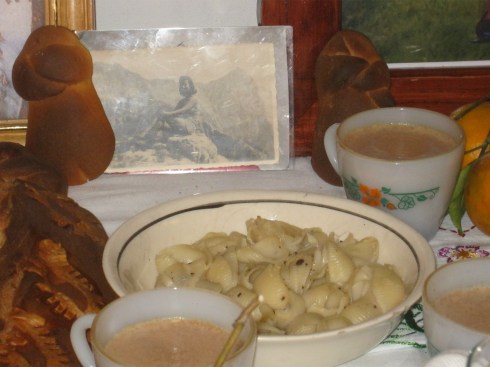
Making the pasta for her, setting it on the altar, lighting the candle for her (and another for my paternal grandmother), was the first time in a long time I’d let myself really think about her and what a gift she was in my life. It was one of only a couple times since she’s passed (about a year and a half ago) that I’ve let myself just talk to her. It doesn’t matter to me if there’s really an afterlife, if she can really hear me, if her spirit really comes to visit or not; it felt good to commune with her spirit, to just believe, the way you could when you were a kid, to let go for a minute of the hurt and the loss of her death and to feel her legacy as the joy that it is. For that, I am grateful.
So even though I missed seeing the kids trick or treating, even though I didn’t dress up, even though I missed some of my other Halloween traditions, this is definitely a worthy holiday that we will continue to celebrate in this family. And we’ll keep on doing it with bowls of pasta next to the mole, and however else works for us, because we like to break the rules in this family, and we can mix up and remake our own traditions, happily ever after.
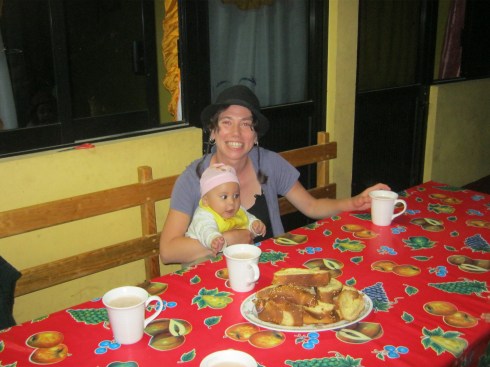
Here’s a picture of Lucia and me at a friend’s house, drinking hot chocolate and eating special dead bread (okay, that’s a literal translation of pan de muertos- a more appropriate translation is something like, Day of the Dead bread)
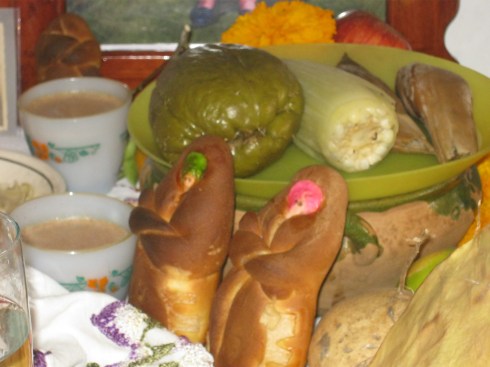
The bread on our altar here below is from the coast- different regions make different breads, of course. Also pictured are some local foods- chayote (like a form of squash), corn on the cob, and hijos de cuateco (Don’t ask me to translate that. It’s a food that grows wild around here.)
Fame without Fortune
17 Nov
Before I even arrived in Mexico, Conan’s mom, Paulina, told us about the other gringas living in the region. There were two. I imagined that Paulina had investigated the situation, since her son and granddaughter and I would be moving soon. But when I got down here and continued to hear about these other two famous women, when I realized that everyone knew about the other gringas, I also realized that it wasn’t that Paulina was particularly interested in other women from the U.S. moving here with their partners- it was that people from the U.S. moving to the towns down here is rare. On top of that, towns are small, and gossip is a way of life.
Now that we live here, I am one of the subjects of that gossip. I spent my childhood being a little odd, and my teen years being vaguely shocking, in the context of a small, close-knit city. I thought that I was used to being the subject of gossip. I was not prepared for the extent of it here. I was not prepared to be this famous. But I’m amused by people’s shameless, matter-of-fact-ness about it, the way they’ll tell you more or lessto your face that you’re practically another species (not usually to your face- because if they told you directly then it wouldn’t be like gossip anymore).
Here are a few examples of our fame and glory here in Juquila:
-When we go to events, or sometimes even just to the plaza, everyone turns their head, cranes their neck, and occasionally lets their jaw drop a bit. This makes poor Conan, who’s already naturally shy and doesn’t like to be in the limelight, even more reluctant to go to events.
-Paulina took Lucia with her down the street to the credit union the other day. “How come you’re out with that baby? Is that couple that’s renting a room from you having you take care of their baby?” someone asked her. They either didn’t recognize or didn’t remember Conan as Paulina’s son, which is understandable since Conan has not been here for 10 years. Still, Paulina was amused that they mistook her son and daughter-and-law for renters in her house.
-People told Paulina, “We finally figured out that that gringa is your daughter-in-law, because we saw her in your store the other day. Before that we kept seeing her in town and wondering why she wasn’t leaving.”
– Conan talks about people copying off of each other shamelessly, and how if it were easier to do, they’d be bringing their own gringas home from the states now that he has. I thought he was joking until Paulina told me that the lady down the street scolded her son, asking him how come Conan came back from the U.S. with a gringa wife and her son didn’t.
-A woman that Paulina doesn’t know came into the store the other day. She said she was looking for a woman who she thought was living there, a woman with a baby, a woman who’s not from around there, a woman who dresses funny, she says. She came because she had seen Lucia and me in town and was dying to hold Lucia.(Lucia cried in her arms.)
-A young woman came into the store the other day when Paulina and I were there together. Paulina was helping her while I was standing there with Lucia. Then the woman starts to talk to Paulina about me. “She’s not from here, is she?” She asks, although it’s really a statement rather than a question. “And look at her haircut- why does she cut her hair like that?” She asks Paulina. “I think it’s because she likes it like that,” Paulina replies, and she and I are giving each other looks because it’s so ridiculous. “She’s even got two little braids on the side.” The woman just keeps on talking about me. I start to feel like I’m on display at the zoo. “OH! And she talks!” she says at one point when I say something to Paulina. Maybe she meant to say “oh, she speaks Spanish,” which many people say to Conan or Paulina while I’m standing there. But what she said was just, “oh, she speaks,” like I’m an animal doing a trick. I thought about growling or howling or making some other animal noises, but decided against adding more fuel to the fire in that moment.
-Many people ask Paulina things like, “What does she eat? Does she eat the same stuff as we do? Does she cook?” And coincidentally, my #1 friend in Juquila has a burger joint, so we decided to have a little fun with that. So now Paulina tells them no, it’s a hard life for me; every day I have to wait till Epig opens his burger place (around 6pm) before I have my first meal, because I only eat the burgers and hot dogs that Epig makes. We based this rumor off of the rumor we heard about one of the other famous gringas (who’s now gone back to the U.S.) who supposedly refused to eat the food in her town, who was making her husband take her to Puerto Escondido (a tourist town about 3 hours away) almost daily for her food.
-On the way home from Puerto after a couple months here, I’m squeezed into the front of the truck with Lucia and other women and children. “Has your baby gotten sick since you’ve been here?” one woman asks. I realize it is obvious that I’m not from here- so it’s reasonable for her to not bother to ask if I’m from here and to move on to another question. But then another woman asks, “So, how do you like living here? Are you getting used to it?” And then I realized- they don’t just know I’m not from here, they also know that I live here. Okay, this is a small town. We’d been here for two months by then. I guess that’s plenty of time for word to get to everyone. But then Conan told me later that those weren’t even women from Juquila; they’re teachers living in other nearby towns. Word has spread that far!
So now I am one of the famous- now there are three of us gringa legends that everyone in the south of Oaxaca knows about. If only we could find a way to profit from our fame, then we’d be in business. We thought about a circus-style display (a la bearded lady) that we’d charge money for, but it’s hard to charge for it when people see us on the street and in the store every day. So let me know if you come up with a better plan.

circus freaks of juquila!
Extreme Driving, A Year- Round Oaxacan Sport
8 Nov
There’s an Isabel Allende novel in which the main character’s parents have a special brake system for their car. They have a stone attached to a rope tied to the car, which the mother (from the passenger seat) throws out the window when they need to stop. They think it’s fine- they’re one of the first families in town to have a car, and they’re sure it’s a pretty foolproof system. Until they eventually die in an auto accident. But it definitely added spice to the story.
We live in the hills of Oaxaca, where the “highways” are all like back-country roads. They’re ridiculously curvy winding roads with steep cliffs at every bend. Only some of the roads are paved, and even when they’re paved, they’re full of gigantic potholes, speed bumps, and other hazards. When they’re not paved, when they’re dirt roads and it’s the rainy season, they can be impassable, or only passable in some kinds of vehicles, and then very carefully. When in that situation, I frequently picture us losing control in the mud and sliding over the cliff, which I’m pretty sure no one would survive. I am a little terrified every time we venture out onto the roads no matter whether the road is paved. But the alternative, to stay in this tiny town all the time, is even scarier to me.
We borrowed a car to go to Camelote. That’s the town where Paulina (my mother-in-law, more or less) is originally from, and where her mother (Conan’s very beloved grandmother) is buried. This seemed like a brilliant plan because a) we could use Lucia’s car seat, b) it would be cheaper, and c) we wouldn’t have to go by the public transport. The transport is not only inconvenient, with only a couple of trips per day, but also it’s uncomfortable, since it is just a double-cabin truck with benches in the back. There’s a hierarchy for who gets the inside seats: women with babies/very small children first, then other women, and only men if there’s still room after that. But no matter where you’re sitting it’s not particularly comfortable. The car would alleviate all of our issues.
The road to from Juquila to Camelote is a dirt road that’s in particularly bad shape, and worse when it’s rainy. One of the times that Paulina returned from a trip there since we’ve arrived in Mexico, she said everyone had to get out and wade across a river to switch trucks, because the river had risen so high the truck couldn’t pass it safely. It’s only been in Conan’s lifetime that any public transport travels the route regularly. When Paulina was growing up, and even when Conan was young, they’d walk the whole route. I understand that it takes about six hours if you’re in good shape, a bit more if you’re with small children. Driving the route can take anywhere from one and a half to three hours or more, depending on the conditions. Here’s a picture of where the river crosses the road when it hasn’t been raining profusely and it’s safe to cross:.
Our first crack in the plan comes when we have the car in our possession and realize there are no seat belts in the back seat. So our plan to use Lucia’s car seat is null and void. Although, after we’re en route and I realize how bumpy the road is, and how slow we go anyway, and the lack of other cars on the road, I feel like the car seat would be harder on her than being in the wrap anyway.
We go in mid October, which is about the tail end of the rainy season. When we’re a good ways down the road, I ask, “So what happens if it rains? Will we be able to make it back today?” “Who knows” both Conan and his mom tell me. “It’s probably best if we stay the night. We’ll see how the road is.” Great, I think. I didn’t bring any pajamas for Lucia, no change of socks or underwear for me, I hope I brought enough diapers for that possibility…
But there’s no point in worrying about all that now; I’m too busy worrying if we’ll make it there alive. Paulina’s friend assured us that her car was in good shape, but it doesn’t seem like it. It is making all kinds of noises and it shakes when you go over 10 miles an hour or so. On top of that, there are all kinds of hazards on the road- huge dips, big piles of dirt, large rocks, and all kinds of other stuff you might see on a driving video game in the U.S. “It’s extreme driving!” Conan says, making his voice like a heavy metal singer, but only a little ironically. “This is way more exciting than driving in the U.S.” he adds, telling his mom about the straight, nicely paved highways everywhere. He’s creeping along, and he’s doing a great job. I have tons of confidence in him as a driver. I know he’s just as concerned about our safety as I am, although surely less anxious. But I have zero confidence in the car and the road. I find myself holding my breath. A lot.
We’re a little over an hour into the trip when Conan stops the car. “The brakes aren’t working very well.” he says. “Didn’t you check the brake fluid before we left?” his mom asks. “Yes; it was fine.” He checks it again. Still fine. But he’s having to push pretty hard to brake. And most of the route is downhill. I am ready to abort mission immediately- that seems like the only sensible thing to do. But we decide to try a little further. The brakes are still working, after all, just not as well as one would like.
I get back in the car very reluctantly. We only make it a few more feet before Conan stops the car again. “No,” he says, decided now. “It’s not going to make it. My foot’s pressing all the way down and it still didn’t stop right away.” I hop out of the car, pleased that we’re not continuing. “Can’t you come up with some kind of home remedy for this?” Paulina asks hopefully. Conan assures her that he has no home remedy mechanic skills, so then she agrees that we’re aborting the mission for today. I am done with the car, ready to walk back to town, and I don’t care how far or how long it takes. (I have peanut butter and jelly sandwiches for us, luckily, so I feel prepared for a long haul.)
But where to leave the car? We can’t leave the car in the middle of the road- even though it is not heavily frequented, it’s a small road so the car would prevent anyone from passing. Even just to turn around, Conan has to find a decent place where the road is wide enough. We decide to go back to such and such spot we’ve already passed, where we can leave the car. Paulina and Conan are sure we’ll make it there, based on the idea that you don’t need brakes to go uphill. But just in case we do need brakes, Paulina grabs a large rock and puts it in her lap. “Just in case,” she assures me. She is prepared to jump out and put the rock behind the wheel if necessary. “Should I get a rock, too?” I ask. “It’s called a brake, Julia,” Conan jokes with me. Paulina says her brake is plenty.
The absurdity lightens my anxiety as we begin the uphill journey towards home. Paulina tells us more about mishaps with cars and how she and her partner Arturo have patched things up. There was the time the gas pump went out and the car wouldn’t start, but since they were going to the coast they just coasted downhill in neutral the whole time. There was the car that didn’t have headlights and they rode around with Paulina pointing a lantern/flashlight at the road. Arturo was so embarrassed that he would pull over every time another car went by so they wouldn’t see their sorry excuse for headlights. There was the time they had to cross a flooded road and Arturo asks Paulina if she thinks they’ll make it across. “Yeah, let’s do it,” she says. And they get stuck and the truck almost gets washed away. As she tells more and more stories, I decide we will probably make it out of this alive, and it’ll be a good story. And indeed, we did make it all the way back to town, alive and pleased to add the rock-brake story to the list. (For the record, we only used the rock once- as a safeguard to prevent the car from rolling backwards down the hill when we had to stop so I could pee. I learned that you really don’t need brakes much when you’re going uphill.)

Conan’s new favorite sport
A New Flavor of Popsicle
28 OctWe have a regular customer who buys a bolis (pronounced bowl-ees) just about every day. A bolis is an awesome homemade popsicle. You use real fruit and blend it with either water or milk (depending on what kind of fruit it is) and a little sugar, then you put it in a small plastic bag, tie a knot in it, and freeze it. You eat it straight from the bag, tearing a little hole with your teeth to suck the juice out.
Since Arturo (Conan’s step dad) often brings coconuts from the coast, Paulina makes some delicious coconut bolis- it’s the water from the coconut, plus the coconut “meat”, plus milk and sugar. The finished product looks like this:

Arturo was in the store alone the other day, and he sold a bolis to our regular customer. A couple minutes later, Paulina goes back to the store, right as the customer comes back with the bolis in hand. “I don’t think this is a bolis,” he says, handing it back. “Oh, sorry,” Paulina says, putting it back in the freezer. She grabs a different one and hands it over to the customer, who quickly goes on his way.
“Arturo, what did you do?” she asks. “What? That wasn’t a bolis? What was it then?” he asks, a little indignant. “Really? You can’t see the difference between this bag and this bag?” She holds up the two bags. Here’s what the other bag looks like:

“I just grabbed it out of the freezer,” he says. “But what is it?”
“It’s Lucia’s milk. That Julia has been pumping and saving up just in case. She keeps it down here because there’s more room than in the kitchen freezer.” The bag even says Lucia, and has a date on it, unlike the bags for bolis. It has “mother’s milk” printed on the bag as well, albeit in English. You would think our regular customer would have noticed that it was different from the bolis he buys every day. But apparently he didn’t notice until after he had opened the bag and started to eat his breastmilk “bolis.”
And nonetheless he came back for more the next day!
A Little Dose of Positivity
8 Oct This blog could use some positivity, as could I. To take some time to focus on the good things in my new environment. Because some days you might believe- and I might, too- that it’s all difficult and crappy. And it’s just not true. (And yes that rainbow is in our backyard.)
So I made a little list of things that make me feel like sunshine on a cloudy day. Number one on that list is my family here- my daughter, my partner, my awesome mother-in-law. But this is more of a cultural list, stuff that I like specifically about this place, not about the people around me.
Granted, the things that I love are mostly food-related. But I am, after all, that girl that prefers the kitchen above all other places in the house. “The kitchen is the heart of a home” said my friend Luis de Leon, and food is like glue that further binds people into loving friendships and family relationships. So I hope you enjoy my little rainbow list, and I’ll cook something for you if you come to visit!
Please not that my list is not in order of importance.
-Epazote… And you thought cilantro was exciting. Epazote is another fragrant and delicious herb that for some reason I could rarely find in Louisville. I especially recommend it for chilaquiles and for black beans. And while we’re on the subject, yerba santa (especially in black bean tamales) is pretty exquisite as well. http://en.wikipedia.org/wiki/Piper_auritum -go here for more yerba santa info. http://en.wikipedia.org/wiki/Dysphania_ambrosioides -go here for more epazote info.
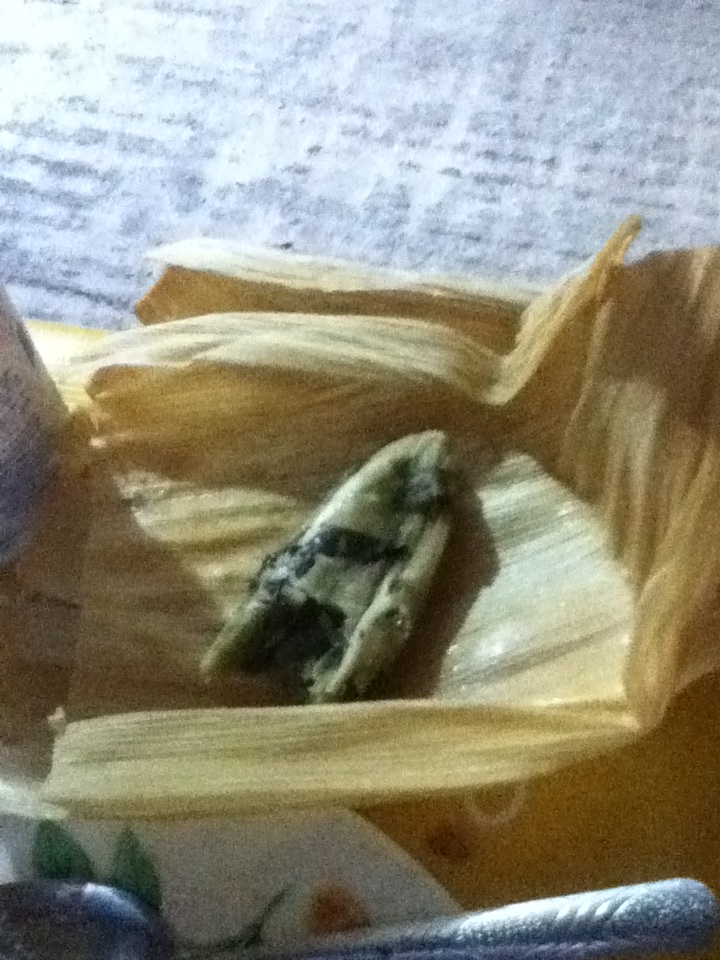
-Chepiles… Looks like spinach, tastes like artichokes. Not like vinegar-soaked canned artichoke hearts- like artichoke leaves. If you’ve never had a whole artichoke, you need to immediately go buy one. Boil for 45-60 minutes. Melt some butter and squeeze the juice of a lemon- a real lemon. Add salt to the lemon juice. Take an artichoke leaf, dip the edge in either butter or lemon juice, then scrape off the meaty part, now dripping in butter, with your teeth. Repeat until you get to the heart, which is a seriously orgasmic example of a vegetable. Then you’ll have an idea what chepiles taste like. Here’s a chepiles tamal:
-Tropical fruit…. including mango, pineapple, coconut, different kinds of banana, and much more are all close by, accessible, and fairly cheap (definitely cheap compared to Kentucky).
-Organic produce is cheaper than commercial pesticide-covered, genetically-modified shit…. Although it’s not labeled or anything, (and there’s no supermarket, either, but this will NOT be a complainy post), the ladies who sit on the ground in the plaza to sell produce are selling the stuff that they grow in their town, which is chemical-free, delicious, local, and cheap.
-The view of the river and the mountains from my window is gorgeous. Look! The picture doesn’t do it justice, but you get the idea.
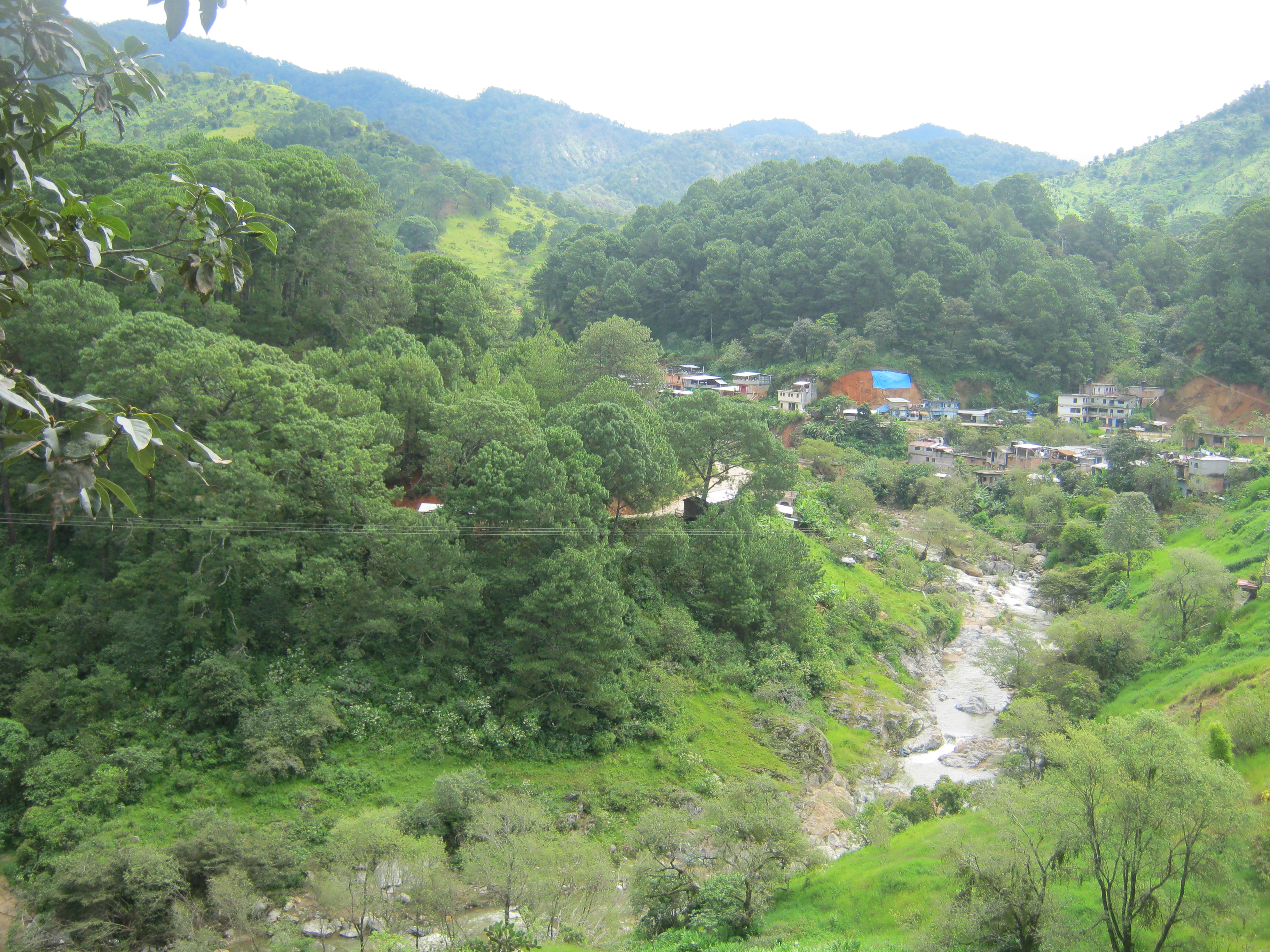
-Almost everything is local business…. People put whatever business they feel like in the front part of their house. This is how many families make a living. So while in the cities you might have a supermarket or other big corporations, most businesses there and all businesses in towns are the businesses of the people who live there. I both love and hate the chaos and randomness of it, trying to figure out where to go to buy what we need. You might have to ask around and get sent to several different places before you find what you’re looking for- like a mosquito net we got to put around Lucia’s bed. You might have to go to a place 3 different times before you catch them open, like when we wanted to get a key made. You also might have 10 different places in the plaza that sell practically the same thing, which is just a little ridiculous. But at least it’s local. And in some ways, it’s more convenient- like you can count on there being all kinds of necessities (basic food products like tomato, hot peppers, rice, beans, eggs, etc.) right around the corner- most of the time.
-Loudspeaker announcements… okay I don’t actually love this but it does amuse the hell out of me. The local government has a loudspeaker that they put on top of a car and drive around making important announcements. Unfortunately, to my untrained ear (and Conan’s too), it mostly sounds like the parents on Charlie Brown. I hear something like “wha wha brr wha arrr importante…. Wha wha brr ig colonia 3 de mayo…. Wha wha pa arr 20 de septiembre ” The other day I caught only the words “papanicolau” (pap smear) and “mamografia” (mammogram). But I have no idea when, where, or for whom. Oh, well.
-The products people sell via drive-by/walk-by…. First of all, there’s a bunch of fantastic street food- tamales, chiles rellenos, breads, sweets, etc.- that passes by our house every day. People walk by selling whatever it is that they’ve made (including fresh tortillas twice a day), which is unbelievably convenient when we need a snack or don’t have time to cook. And then there are the things that get sold via truck- the gas we use for the stove and the hot water heater, the big bottles of drinking water, pizza, mattresses, and more. We woke up our first morning in Mexico to a car driving by announcing “Atole! Atole!” (which is an oatmeal-based drink), and realized we were definitely in Mexico after all. Selling heavy stuff via truck is great because we (and many other folks) don’t have a car to go pick stuff up and bring it back. The downside is you have to be home and paying attention to get those things. The gas truck at least makes a weird moo-like sound, then plays some music, and announces “gas de Oaxaca”. I refuse to buy pizza because the announcement/song is too irritating. But many things aren’t announced- you just have to watch for them, which is how we missed the water truck that has the water that tastes good for like 3 days in a row.
-Cheap(er) access to medical and dental care. What’s not to love about not stressing out about whether you can afford to go to the doctor or not?
-There’s not a lot of processed food (also a downside occasionally!).
-Breastfeeding wherever, whenever, with no dirty looks, rude comments, or even the bat of an eye…yep. I know, all you breastfeeding moms in the U.S. are jealous now.
-Street-life exists…. The town feels alive. There are always people walking to get places (and horses and cars, too). Big events happen outside, usually in the plaza. Houses are open. The environment is more public, open, not private, shut out.
-Handmade, fresh tortillas every day…. Yes, I mentioned this in the products people sell via walk-by section. But it’s worth mentioning again. It’s pretty great.
-No lawnmowers- only machetes… First of all, people don’t have stupid lawns like they do in the U.S. (and not a lot of grass that’s not eaten by cows and such anyway). But when there is excess grass you cut it with a machete. That’s right. No lawnmowers. No leaf-blowers (the bane of my existence/the epitome of US waste and laziness, in my humble opinion). None of that ridiculous noise and poor use of petroleum. And you can even hire someone to cut your grass. We had some insanely overgrown mess all around the back of the house and a guy cut it down for like 15 bucks (US). I know, you wish you had a machete.
-No tornados…. That’s right, I can finally enjoy a storm in peace. No sirens. No National Weather Service beep beeps giving me panic attacks. It’s just a simple storm.
-Patriotism is reasonable and for a limited time only… Mexican independence is celebrated in September, and the whole month you’ll find flags everywhere, and other signs of patriotism. But then, it’s over. October 1 rolls around and all that blatant national pride disappears from view. Sure, people still love their country. But they’re not all up in your face about it, and they don’t go around insisting to everyone and their mom that they’re country is better than everyone else’s. It’s patriotism I can respect. Fancy that.
….I’m sure there are other aspects of life here that I appreciate and enjoy that haven’t occurred to me in time for this post, so I’ll keep you updated, and try to keep busting out these little rays of sunshine from time to time. Since we’re almost out of the rainy season, and I’ve been here over two months now, I’m sure sharing the positivity will get easier. Stay tuned!
Nevermind the Pharmacists
8 OctPart One on Health and Safety: Doctors, Medicines, and Vaccines (oh, my!)
People in the U.S. have strong opinions and culture around health and safety. I hesitate to post this, because even while I feel critical about my new adopted country, I also feel protective of it. I know that my critique could be used as more fodder for the kind of people who are already xenophobic, people who are hateful and/or fearful about Mexico, Mexicans, and/or other immigrants to the U.S. Of course, all I want is to share some anecdotes about our adjustment to this country, and probably those xenophobes are not reading my blog anyway. Nonetheless, other well intentioned folks, potentially some people who I love and who care about me, are liable to be just as appalled, just as worried and upset and condemning about this country- which, after all, is the country where my partner was raised, and the country where we are raising our daughter for now. It’s a country where my heart lives now, and one that I’m not leaving anytime soon.
It is hard to share some of the negative or difficult things about my life here. People sometimes feel bad for me, feel pity, feel dismay, want to save me from it somehow, or just can’t fathom it. But I want to share, so that someday, when I go visit my city again, someday, when potentially we move back, someday, when you and I chat on the phone, the bridge between our experiences won’t feel so vast. So I hope that people can read this, and all the other negative, critical, difficult, or just wildly different things that I post, and keep in mind that this is just where I am. Every place has serious flaws, including and especially the U.S. I am not sharing this so that people will worry, or be shocked, or feel sorry for me. Rather, I want to give you an idea of my landscape, so here goes.
Doctors
My first experience with a doctor here was fantastic, since I didn’t have to leave the bed. Conan called his cousin who’s a doctor, explained my symptoms, and the cousin prescribed an antibiotic for me. Brilliant.
However, the same informality makes me nervous in terms of my baby. When we took Lucia for her first check-up, I diligently took all the paperwork from the hospital and the doctor’s office in Louisville. But the doctor didn’t even start a file for her- not a single note was taken, except by me. He also didn’t do all the same routine stuff like they do in the U.S., although maybe not all of that’s necessary? This doctor is a general practitioner, not a pediatrician, so maybe that’s the difference? I’m not sure that check-ups are the norm, so maybe that’s it? I did find out recently that there is one pediatrician (and one gynecologist!) in this town, so we’re discussing the possibility of going to see him/her for Lucia’s four month check-up.
It’s not like we have an appointment for her check-up. That’s because there are no appointments here. You just go to the doctor when you need to see a doctor. You wait if they’re not available. They have longer working hours, although they also might not be there at all, randomly. This is because most people work out of an office attached to their home. It’s nice for everyone concerned, as far as I can tell. The doctor doesn’t have to be twiddling his/her thumbs in the office if there are no patients- they can be in their house doing whatever they need or want to do there, and just slip in when a patient comes. The patient has more access to the doctor since the doctor’s “office hours” are longer, since the doctor doesn’t have to be there the whole time. The patient decides what time and day to go in. And wait times don’t seem to be longer than in the U.S., where you wait despite having an appointment.
Medicine
Antibiotics and other medications don’t come with 3 pages of warnings and information, either. They come with as little information as possible, it seems. The one bit of information mine had on it said do not use while pregnant or lactating. Even though I heard Conan tell the doctor on the phone that I was breastfeeding. Even though Conan says the doctor says that he’s gonna prescribe me a not-so-strong antibiotic since I’m breastfeeding. Even though Conan says the pharmacy person looked in some textbook to make sure it was okay. So why does my package say it’s not okay?
I’m 3 days into it at this point, and almost decide to panic. I’m also in Oaxaca City, not Juquila, so I can’t just go ask the doctor. I decide to skip my dose for the night and go ask a pharmacist in the morning. So when we pass by a pharmacy the next day, I say, “Hold on. I’m just gonna go ask about the medicine real quick.” There’s a guy that looks like a teenager working behind the counter- I avoid him. Then there’s a woman who looks like she’s at least a little more in charge, and not a teenager (no offense teens, but I’m looking for medical advice).
I approach the woman and explain the situation. “Well,” she says in a school-teacher voice, “that’s right. Antibiotics are bad for babies. It damages them.” I just look at her for a minute. “Really? All antibiotics? So pregnant women and breastfeeding women can’t take any antibiotics?” I ask, catching myself before I raise my voice. “Correct. It’s dangerous.” She affirms. I want to channel my Nonna and ask her where the hell she learned that. I want to tell her that I know that’s not true, that there are different classes of antibiotics and they affect fetuses and babies in varying degrees. I want to tell her it would be insane and more dangerous if pregnant and breastfeeding women couldn’t take any antibiotics ever. I want to scream at her that she’s probably doing more damage to women telling them they can’t take antibiotics. Instead I stare at her again for a minute, controlling myself, and give her my best sarcastic “thank you,” and storm out of the pharmacy.
“How can she be a pharmacist?” I ask Conan irately. “She’s not a pharmacist, Julia. She’s just some woman who works in a pharmacy.” He explains. “Then where is the pharmacist?” There isn’t a pharmacist, he tells me. So imagine, it’s like there’s just the Walgreens clerk there doling out your medicine. Not someone who’s studied medicines. Someone who’s maybe graduated from high school. This is the norm. Fabulous.
Antibiotics also don’t come in the quantity that you need, for some reason. They’re prepackaged, so you might have to buy a couple of packages and then have some leftovers. I didn’t realize this until Conan got an antibiotic. He was prescribed to take it for 7 days but there were only enough pills for 5 days. Then when he went back to get some more they were out of it, so he went back to the doctor and got prescribed a different antibiotic to take for another 5 days. Not particularly efficient, to say the least, but surely there’s some reason for it? I guess so the non-pharmacists can’t mess it up? Any other ideas, anyone?
Vaccines
Before we arrived in Mexico, we researched vaccines fairly extensively. Mexico and the U.S. have pretty much the same vaccines, and more or less the same schedule, which made things a little easier. We had decided, however, to delay the Hepatitis B vaccine (routinely given at birth), and had delayed the rotavirus vaccine, and were discussing skipping it altogether. Then we arrived in Mexico, and were told by a doctor that you can’t opt out of or delay any of them. They’re obligatory- and supposedly more necessary than in the U.S., according to some.
Vaccines are also free, which is great, though it means the demand outweighs supply regularly. They are only given at hospitals and health centers, not at doctor’s offices. When we went to the hospital to get the 2 vaccines Lucia hadn’t had yet, they were out. The rotavirus vaccine can only be given within a certain time frame, and time was almost up. Since it’s slightly unpredictable when a new batch of vaccines would get to Juquila, we needed to get it elsewhere. While I wasn’t that worried about her not getting the rotavirus vaccine, I didn’t want them to make her get it outside of the time frame that’s been studied as the same time frame for the vaccine.
Luckily, Conan’s mom knows somebody- a key factor in any country, as we all know. So she called her nurse friend in the next town over and got the okay for us to go to the community health center there. I, of course, have to pee while we’re there. The bathroom looks relatively clean, but I go to wash my hands and there’s no soap.
Now, this is a situation that happens often, and I could do a whole post on the lack of public restrooms and lack of toilet paper and lack of this and that, thanks to my incredibly small bladder helping to over-inform me about these things. But we’re in a community health center! There’s a sign over the sink that explains how to wash your hands effectively and tells you about the importance of hand washing. And there’s no freaking soap. And while I’d already learned to carry hand sanitizer with me everywhere, the idea of all those sick people and no soap is enough to make me ill on the spot. (I will say that the nurse in the health center washed her hands with soap in the sink right in the exam room before giving Lucia the vaccine, for the record. Thank you, hygiene gods.)
To be continued…..
A Work-in-Progress, Day after Day after Day
26 Sep
You could say I’m stuck in the life of a white, middle-class, 1950’s housewife- minus the valium and fancy appliances. Or some days it feels more like that movie Groundhog Day- where I wake up to the same old monotony, day after day after day. If you’ve never been outside of the U.S., you might not understand how much patience is required. Everything is slower. It’s all a process. All the time.
For me, in addition to being a city girl, raised in the land-of-convenience, I’m a habitual multi-tasking over-achiever. Despite having travelled a lot and learned to (temporarily) go with the flow, I tend to think patience looks great on others, but for me is a really boring, overrated virtue. I catch a glimpse of it in myself from time to time, or in certain contexts (like when I’m teaching, I can be the epitome of patience), but then it slips out of my greedy little hands when I wish for it the most. Such as when trying to accomplish anything in Mexico- aka daily life. Let me paint a little picture for you.
The first 4 or 5 hours of my day, every day, look like this:
-Get up, shower and get dressed. Go upstairs and put water to boil on the stove.
-Attempt to sweep the puddles of water off of the upstairs floor/porch/roof (whatever you want to call it- the top floor of the house in the part that’s open air)- because it inevitably rained at some point in the night and the concrete is uneven at certain points of the roof (which is flat).
-Put the clothes that didn’t dry yesterday back out on the line. Try to keep an eye on the coffee or it’ll boil over.
-Start washing diapers. Now technically, we have a washer. But it is not a washer like you probably have, or like you have access to at the laundromat down the street from you. It is a washer which sometimes manages to swirl the clothes around a little bit before I have to take them out, potentially scrub on them some more, rinse them, and squeeze as much water as I can out of them. Then I hang them on the line to dry and try to stay close by because it could suddenly start to rain at any moment in the day. Notice I say “start” washing diapers because as you can imagine, all of this is a process and I am also taking care of the baby and potentially still waiting on coffee and other such tasks that I probably shouldn’t bother trying to multitask. Taking care of Lucia means talking to her while I do things, hoping she plays with the giraffe that hangs on her carseat, trying not to feel guilty about letting her sit around in her car seat all morning, putting her in the wrap when she won’t sit alone anymore, feeding her when necessary (which of course is like a giant pause button on all these morning tasks)…. You get the idea. Slow, slow, slow.

clothes rinsing and spin cycles
-Wash the dishes from last night, since it was probably raining when we finished eating dinner, or else it was just dark and we were tired and didn’t feel like it. (I think it only rains like this about 6 months out of the year?)

the dishwasher
-Coffee is surely ready by now, having boiled for a few minutes and then sat on the stove to let the grounds settle at the bottom. I drink some coffee and start to feel more alive.
-Check and see if we have enough ingredients or appropriate leftovers for almuerzo, which we might call breakfast except it’s late in the morning, around 10 or 11 o’clock. (I note here that this schedule of eating is perfect for me. Thank you, Mexico.) If not, go to the appropriate place to buy whatever. The appropriate place is usually some version of a corner store which is some neighbor’s storefront. Although sometimes you need stuff from the centro, which is a further walk. Not somewhere I’m willing to go in the morning- if I didn’t go in the afternoon then oh well.
-Start cooking, or heating stuff up, etc. Hopefully the woman down the street who makes tortillas by hand has passed by and brought the tortillas for the morning. If not, someone’s gotta go get them.
-Sit down to eat. Feed Lucia first, because she’s probably hungry again by now.
-Wash the dishes.
-Now it’s time to go out and get supplies/food, or run errands or whatever. Hope it doesn’t rain while we’re gone.
-Get back and it’s time to start cooking for la comida, another fairly big meal that happens around 3pm.
This is my morning/early afternoon, more or less every day, over and over. Often Conan’s mom is here and she takes some of these responsibilities, and Conan also does some of them plus some other relevant stuff. Some of this would be a slow process no matter what, by virtue of having a newborn baby. But this gives you an idea of how my time flies, filled with non-glamorous non-adventures. The rest of the afternoon usually holds other non-glamorous and slow tasks as well. This is part of how I end up not having time to write. This is how I end up so often feeling bored and frustrated, like I’ve accomplished nothing in the entire day, despite being busy all day long.
But I guess I accomplish living another day. Raising my daughter another day. Being with family another day. Learning how to navigate another culture, another phase in my life, for yet another day. And maybe I don’t cross off much on my to-do list, but when I accept that this is my life, and not actually some 50’s TV show nightmare I’m going to wake up from, I find moments of joy. I shamelessly sing off-key to music while I wash, despite the neighbors hearing me. I tell stories to Lucia while I cook. I check my facebook while I feed Lucia. I chat with people. I find time to laugh. This is my life, and it’s just how it needs to be, if I can just remember that I’m my own main character. Even if I didn’t write the script, if I don’t always have much control over the circumstances, I decide how I act, and how I’ll live. And I decide I don’t need Valium or (many) fancy appliances. I throw away my to-do list and decide I’ll put passion into monotony, and that’ll be even better than patience. Even if it takes forever.
Epic Burgers
5 SepI didn’t plan to come to Mexico to eat burgers. Yes, burgers. Not burritos. Not chimichangas (which aren’t real Mexican food anyway). No. Burgers. Go figure. I’ve been a vegetarian, most of the time, since I was 11 years old. The exceptions have been mostly when I’ve been out of the U.S., which has been quite a bit in the past 10 years. Even so, the past several countries have all been in Latin America, and while I’ve eaten meat there (even Chilean versions of hot dogs!), I have not eaten a burger in at least 7 years. I believe the last time I ate a burger I was in Italy, with a horrendous case of boot-rot, and in an effort to avoid walking my travel partner got us McDonald’s, since it was the only very close food available where we were staying. (We swore each other to secrecy from the shame and irony.)I don’t even like burgers, or most meat, really. I eat it when I’m away because I want to try all the typical food in a country, because it’s convenient and I don’t always have access to what I would normally cook for myself, because I don’t want to reject food that kind people offer me. But I don’t get excited about meat, especially burgers.
But we walk down the street to visit Epic (whose name is actually Epigmenio, who people call Epig, which sounds more like Epic). I am not planning on eating a burger. But I am desperate to get out of the house, so I gladly accompany Conan, with Lucia wrapped up against my chest, of course. Epic is friendly. He speaks directly to me. He smiles- and has very cute dimples, by the way. He has that idiosyncratic I’m-super-busy-working-very-fast-but-it’s-all-cake-to-me, laid-back attitude that experts in the service industry do so well. It’s the first time I’ve seen that attitude here in Mexico, where tips do not prevail. It takes me back to that camaraderie of the restaurant business in Louisville. He chats with us despite the blaring volume of telenovelas, which he glimpses at from time to time- super multitasking, as busy as he is that night.
I can’t believe how many people come for his burgers. That night he runs out of burgers, so many people come, but he still has some hotdogs left…. More than the sheer quantity of burgers, I can’t believe what these burgers look like. I watch him prepare plenty of them before he gets around to taking our order- and by then I’ve decided that yes, I have to have one. Because these are Mexican burgers, after all. And not just Mexican burgers- these are fucking epic burgers.
Let’s see if I can manage to name all the ingredients:
-the burger (which I might add, is local beef, ground the same day, formed into patties by hand that afternoon- although I didn’t learn that till later)
-american cheese (or some equivalent of gross orange-yellow version of cheese, ew)
-bacon
-ham
-pineapple (for the Hawaiian burger, which I ordered)
-quesillo (delicious Oaxacan melty cheese)
-fried onions
-lettuce
-tomato
-avocado
-jalapeños
-ketchup AND mustard AND mayonnaise
And the verdict is in…. they’re fantastic! (Okay, so I got mine without bacon or American cheese. Even when doing as the Romans do and all that, you gotta have some standards.) You might think I can’t make a fair comparison, since I hadn’t had a burger in years. But come on, converting a vegetarian is a pretty impressive feat. I advise you all to abandon your fast food burgers immediately, and high tail it to Juquila.
Even more important than the burgers (and what, you ask, could be more important than burgers?), I’m turning Epic into my first friend in Juquila. Call it instinct, sixth sense, intuition, whatever- Epic exudes friend-material energy; he’s friendly but also, I think, sarcastic and skeptical, he’s funny and giggles easily, and I think he’s strong and tough and nice and lovely. I don’t actually know him, especially not that first night when I go and eat his hamburgers, but I warn him that same night that he’s gonna end up being my friend. More details on that later, but I will mention that so far so good- he’s even the first visitor that’s come to the house to see ME (not for Conan, not for Lucia- but to talk to me!)…. I think it’s gonna be an epic friendship.



Help Me Keep Writing

 exile to mexico