The Little School-House Built on Loving Learning

22 May

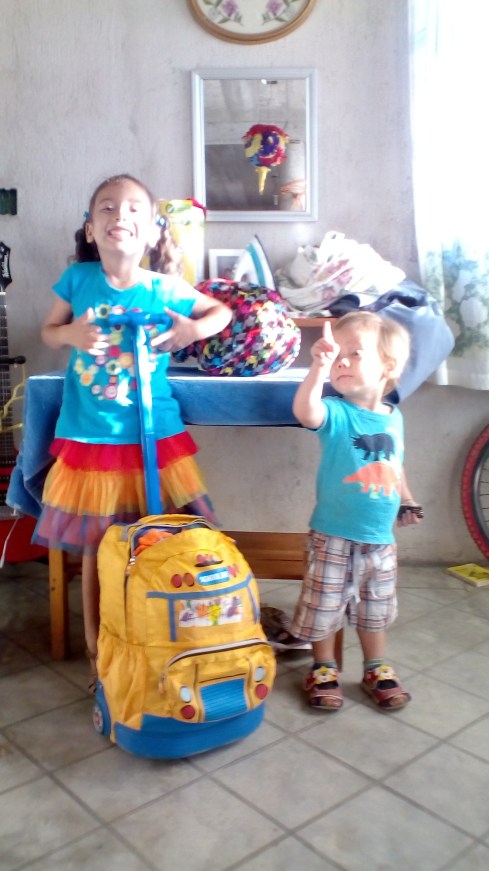
If you had asked my opinion a couple years ago, I would have told you that I suspected that Waldorf schools were just for rich hippies, and therefore had nothing relevant for me or my children. Funny how parenthood changes so many of your ideas about life and parenting, though. Parenting has schooled me hard on humility, made me more open to changing my mind, and forced me to always take circumstances and context into account along with all of my theories and ideals. Now both of my children are in a Waldorf preschool program, and I could not feel luckier or more pleased about it.

My bias, though, first of all, was that I didn’t think that I would send my kids to private school. On principle, I’m against private schools because quality education should be free and available to all, and we should all be fighting to make public schools better. Of course, I also know firsthand that too much of the time the best thing to do is to get the hell out of the system. I did not imagine that I would need that option for my kids’ preschool, however. I didn’t have any expectations for my kids to graduate kindergarten as geniuses. I figured I’d be teaching my kids to read and write myself anyway, and that I just wanted them to go to preschool to get out of the house and play with other kids. Why pay money when your standards are minimal?

Little did I know that those minimal expectations are not the objectives of public or private preschools around here. They all seem to want three year olds to be sitting around copying letters and doing homework and other meaningless and useless activities that I just can’t accept. And I’m too tired and too busy and too foreign to take on the education system just yet. Plus my littler one is still only two, a year too young for compulsory education here in Mexico. So if I’m going to pay for his schooling/care anyway, it might as well be a program that’s good for him, and it might as well be with his big sister.

My other bias was that I always wanted my kids to be in Montessori schools like I was. Maria Montessori is one of my life heroes, and I can 100 percent get behind her educational philosophies. Montessori is all about hands-on learning and giving kids lots of options and control over their learning. It meets kids where they are in the educational process, giving them the tools and guidance they need without over-structuring their lives. (Read a brief introduction to Montessori here.) But there is no Montessori option here. And Waldorf actually has some things in common, as well as some separate ideas, that make it very worthwhile. (more extensive info about Waldorf here)

Furthermore, what really sold me on this particular Waldorf program was the person who made it happen. From there I fell in love with the wonderful teachers, too, as did my children. I got to know other parents in the school, who are amazing people. Certainly the school’s inventor and director made a world of difference in my bias, however. Because she’s an unschooler* at heart, like I am- an anti-authoritarian, anti-system, humanistic, respectful person right down to her core. She is engrossed in and passionate about all things related to autonomous education. She values all children and adults for the fully human and unique people that they are. She respects and facilitates the processes of learning for everyone, without pushing anyone. She is constantly learning, with a big full and open heart, and the joy in her mission spreads like wildfire. That is what I want my children to be around. This is the environment I want for my kids, for all kids, as they build the foundation of their little fabulous selves.

The teachers she found and coached and trained are an amazing pair themselves. They are so open to ideas, and so attentive with the kids. One of them is super outgoing and exudes a sense of fun and adventure, while the other one is very tender and maternal and calm. They are both incredibly patient and caring- traits that sometimes we as parents struggle with.

My kids certainly- and from what I can see, it seems like all the kids- feel safe and secure and valued at school. They don’t treat kids like problems there, even when their behavior is problematic. They have firm boundaries for the kids, but don’t put unrealistic or impossible expectations on them. They pay attention and recognize kids’ different needs, and help teach the kids’ to respect their own and other people’s needs. (For example, when the littler ones snatch toys away, the bigger ones often say, “Oh, it’s because she’s so little.”)

Importantly for me, my kids want to go. They have a good time and they learn like the sponges that they are. When my daughter first started there, she even asked to go to school on Saturdays! I’m also eternally grateful to have somewhere “childproof” to send my irrepressibly active two year old. There’s pretty much nothing at school that sets off the string of “NO!”s that unfortunately happens at my house often. The inside and outside areas are set up for kids to explore freely, even for very adventurous two year olds. Of course both of my kids come home with bruises and scrapes sometimes, but that’s so preferable to trying to make them sit down most of the day.

The school is not officially a school, but rather called a “home extension” program, which is so much better than both regular school and day care. The kids start their day with songs and circle and community. The big kids go for a walk around the neighborhood. One day a week they cook their meal together. One day a week they bake bread together. They always sit down together and eat out of glass bowls and plates together, and the kids wash their own dishes afterwards. My kids always devour all their lunch, because they get to work up an appetite beforehand, and aren’t forced to choose between eating their food or more time on the playground.** They have a very set routine with lots of freedom worked into it. They have lots and lots of bodily autonomy and movement. They don’t have workbooks; instead they have lots of story time with real and interesting books. They sing tons of songs, which Lucia loves. They make things. They create, invent, and use the hell out of their wild and beautiful imaginations. They learn to take care of each other, play together, help each other, share, collaborate, and problem-solve together, which are lifelong skills and values that are just as important as literacy. They get literacy skills aplenty as well, it’s just worked into their day naturally, through play and real life experiences.

I still wish this amazing and wondrous house of learning were free for everyone; it’s the only fault I can find with it. But it’s not actually the fault of the school or its creator; I also know that the government would never, ever, ever fund such a thing here. Something that encourages autonomy for children? A space for parents to critically analyze the system, our parenting, and all the things we may have been taught are the right way? Not gonna happen.

Meanwhile, however, the very existence of this “unschool” is planting seeds to change the future of education in Oaxaca and in the world. Because of this school, I end up talking to a lot of parents about the benefits I see from this style of education. I have conversations about educational and parenting alternatives. (Even when I just mention that the kids help cook something on Tuesdays, other parents’ ears perk up.) I imagine that other parents at the school do the same, spreading words and ideas to other parents. Above and beyond that, though, our very same principal is out all the time spreading her wildfire passion for lifelong education. She’s all over the internet with her radical ideas. She has a regular slot on the radio about parenting and education, and the radio is the most accessible forum around here. She doesn’t just want this lovely little program for this little group of kids. She wants to set the world on fire and build a movement of autonomous education for all. And she’s doing it. Changing the world is slow going, but nobody can say our beloved directora isn’t fully committed, body, heart and soul, for the long haul.

So maybe Waldorf schools in some places are schools just for wealthy hippie types, but that sure is not a fair or accurate description in this case. Luckily for me, you’re never too old to unlearn your own biases. I’m so incredibly grateful that this hotbed of learning exists, and that my kiddos, my partner and I get to be a part of it. I couldn’t dream of a better place for our family to belong.

(In case you are wondering, especially those of you in Puerto, the preschool program is called La Casita, and the mind and heart behind it is Rebecka Koritz.)


*from those dear folks at wikipedia: “Unschooling is an educational method and philosophy that advocates learner-chosen activities as a primary means for learning. Unschooling students learn through their natural life experiences including play, household responsibilities, personal interests and curiosity, internships and work experience, travel, books, elective classes, family, mentors, and social interaction. Unschooling encourages exploration of activities initiated by the children themselves, believing that the more personal learning is, the more meaningful, well-understood and therefore useful it is to the child. While courses may occasionally be taken, unschooling questions the usefulness of standard curricula, conventional grading methods, and other features of traditional schooling in the education of each unique child.”  I was unschooled through most of high school, and I got the best education I could have dreamed of! Because, you know, there was no Montessori or Waldorf high school.

**Granted, my little ones are total chowhounds. They even nicknamed my littler one Cookie Monster. When I ask him what he did at school today, he always tells me, “uhm”- his noise that means eating. My big one is also a chowhound, but she never ate her lunch at her other school.

Mother’s Day Homage to my Feminist Bad-Ass Hombre

14 May

I’d like to thank my husband, first and foremost, for never, ever giving me Mother’s Day gifts related to cooking and cleaning. No new broom or Tupperware, and heaven forbid it- no iron for me, thanks. Probably he guessed that I would spend my life in jail for murder if he gave me housework-related things as a personal gift. So despite the hundreds of stores and street vendors hawking such appalling things for Mother’s Day each year, he has not once in these 4 years of my motherhood in Mexico fallen prey to such nonsense.

He also doesn’t mind that I insist on celebrating twice a year- both on May 10, the official day in Mexico, and again on the second Sunday of May. I mean, we’re a bicultural family, right, and this is what it’s all about. Double holidays for everyone!*

What I most love about my coparenting partner, though, is that he’s a total radical around these parts. Not only does he see my point on all of my culturally distinct ideas on gender and parenting, but he’s also right there with me and has my back about it. I suspect he actually cares even less than I do about what people say about us, our parenting, our family gender roles, and our children. Which means he has not one single turd of caca to give on the matter.

From the get go, he shrugged off people’s shock about baby Lucia not getting her ears pierced upon birth. “But it’ll hurt her later!” They said, as if the baby doesn’t feel it when she gets her ears pierced, and with the assumption that she’ll want to get her ears pierced later. “But people think she’s a boy! She doesn’t even have hair!” Folks complained, and he not only shrugged but started calling her Pablo on the days she wore “boy clothes.”

Then we did some big-time role switching. I went back to “El Norte” to work and save up some money, and he stayed down here to get our house built. That switch was more of a funny cultural thing, since it’s much more typical to have a young Mexican family in which the man goes off to the states to work and save money to improve the situation for the family and the woman stays home. So okay, I took our kid with us, but it still sounded funny compared to the normal narrative here.

It wasn’t quite as funny, though, when I got a full-time job here and Conan became an official stay-at-home dad. He was the only stay-at-home dad along the entire coast of Oaxaca, if not the entire state. You can read all about the peer pressure and shaming that he put up with for that brave endeavor, right up till last November (read about it here a bit). It was a situation that was really practical and beneficial for our family, especially for our children, and yet even other moms acted like he was being lazy, despite knowing how much work it is to raise a family, what it takes to stay home and care for small children. Through all the criticism and gossip, he just kept on doing the best he could for his family.

While some people thought his whole Lucia-as-Pablo joke was pretty cute, folks are much less forgiving about boys breaking out of gender roles. So I was nervous about what Conan would think when our little boy wanted to wear a dress on a family outing one day. Do you know what he said? The same thing he says on the days Khalil picks out shorts and a t-shirt. Nothing. I momentarily underestimated Conan’s rebel streak. I forgot that he is just as fierce as I am about living life outside of boxes (although he might be less belligerent about it than I am).

There are countless other examples of why Conan is a badass feminist partner and father. Every week there are new things that I realize about him, or things I see as the norm in other people that make me realize how distinctly cool my husband is. Just this week, a female coworker of Conan’s gave him a hard time the other day about the staple he keeps putting in his shirt to make up for the missing button. His coworker says to him, “Conan, your shirt is sad! We can see who’s the boss at your house.” Obviously, if he had a good wife, she would fix his shirt. (No, his coworker didn’t say that part out loud.)

When Conan repeated this to me I turned red- not from embarrassment, because I do not feel the slightest bit bad about not being an on-call button-sewer. I am already fulfilling my inordinate amount family responsibilities to the best of all my abilities, and I furthermore have full confidence in Conan’s ability to problem solve and figure out his own remedy to a missing button. Nope, I turned red from fury. Why? Why do other women buy into the patriarchy so much? Do they so desperately need validation that they think you need to put me down as a woman and further imply that my husband isn’t a real (aka bossy) man because he doesn’t force me to follow my assigned gender role thoroughly enough? Barf. “What did you say?” I asked him, appalled. “I didn’t say anything,” he replied- as usual, ignoring his way around ignorant and annoying people.

Not only does he not expect me to sew on his buttons, but he also believes that I am a full-fledged human being, deserving of personal time and even occasional social time that doesn’t include him. I wish that I didn’t even have to include this as part of what’s awesome about my partner, but compared to so many other people’s relationships, this belief system of ours as equals is akin to something like folks trying to build an igloo right on the beach.

Being the unconventional family that we are, what could be more perfect than appreciating my children’s father on Mother’s Day? I wouldn’t be the same mom that I am without his revolutionary beliefs and back-up. So thanks, Conan, and thanks to all the radical men and dads, to all the trans and gender-nonconforming folks and parents, everywhere. Let’s keep making this world a better place, and backing each other up, and, in honor of Conan, giving zero fucks about what other people have to say about it.

Happy Mother’s Day- to us, and you, too!

*I would like to point out that I think it’s sexist and crappy that Father’s Day here is always on a Sunday, just like it is in the US, and yet Mother’s Day falls any old day of the week, presumably because moms are not in the labor force, which is less and less the case all the time.

Two Little Arrows out in the Wide World: Musings on Children

1 May

I send our little boy out into the world with a pink and blue tutu, heedless of the consequences. I’m not concerned, although I suspect the babysitter is. Our son has very firm ideas about what he wants already, plus he loves to copy his big sister, and many of his life’s joys are the same as hers. This includes a passion for shoes and tutus, as well as an extraordinary ability to prolong bedtime by bringing more and more books to the bed with a pleading look in his eyes.

Mostly when he wears his tutu or his dress (things he has borrowed from Lucia and made all his own) strangers just assume that he’s a girl. Obviously, folks who know him know that he’s a boy, and reactions have been mixed. First folks are kind of taken aback. Some folks have a strong reaction of “WTF,” while others have a milder sort of head-shaking tsk-tsk version of it. LIke, “Why would they put a skirt on this poor boy? These strange people!” When people ask about it and I tell them he’s matching with his big sister, they seem to be a bit more understanding about it. I kind of resent having to give an explanation for my two year old’s style, but at least that keeps most people from freaking out that boys can’t wear that- at least in the presence of my children. I don’t want too many people contradicting our family values that all people can wear whatever they want.

18217685_1424487244274985_1164920090_n

Protesting nap time, with Lucia’s shoes on, on the wrong feet, of course. 

People thought it was weird when we dressed Lucia in hand-me-down “boy clothes” when she was little, too. People were not ever shocked and appalled, however, in the same way that some people are about Khalil wearing a tutu. I could talk my feminist theory talk about why I think Khalil is more distressing for them, but that’s not my purpose today.

Partly, I’ve just been thinking about how easy it is for me to let my children be themselves- sometimes, and in some respects. And how hard it is to let my children be themselves in other ways.

Take, for instance, Lucia’s invented new hairstyle. I’m not the slightest bit worried about the other parents out there judging me or her because her hair is like a 4 year old version of some punk-rock hair cut (it kind of looks like someone was drunk while braiding her hair). I couldn’t care less about anyone reporting her to the fashion police for her favorite outfit, which involves pants, a tutu, and a shirt/skirt one-piece all at once. (YES! Wear all your favorite things at once! Yes!)

18217821_1424486937608349_1594947683_n

Here you can kind of see one version of Lucia’s favorite outfit, as well as her badass hairstyle. 

It’s easy enough right now for us to plant and water these seeds in our kids’ heads- that they can wear whatever they want, that boys and girls can do anything, that girls can have boyfriends or girlfriends, and boys can have girlfriends or boyfriends. Since Lucia already has a “boyfriend” at her preschool, the who-can-be-your-partner conversation has already happened. I had to give her examples of friends of ours that are “novios con novios” or “novias con novias” so that she would believe that I wasn’t making it all up. I felt totally rewarded in the parenting department one day when one of her friends was over and I overheard her talking about how so-and-so at school could go with so-and-so, because you CAN have girlfriend with girlfriend, because her Mommy said so. Of course I worry a tiny bit about what will happen when her peers’ opinions hold more weight than mine, but I realize that all I get to do is plant and water seeds and see how they grow.

That part is easy for me. Based on my background, and my values, I have possibly too much confidence about being able to sow healthy and open ideas in my kids’ heads about many things. But I realized that there are certain other things about my kids that I just keep fighting against, and that it’s time to evaluate that.

Like the sleep thing. Lucia has had major sleep problems since she was pretty itty-bitty. She has a hard time falling asleep (my genes) and a hard time staying asleep (Conan’s genes). One night when I was putting her to bed late but happily, she told me, ever so wistfully, “I can’t wait for it to be morning.” And I thought, “Why do I begrudge her this so much?” This bright little heart never wants to go to sleep, so deeply and intrinsically, that even when she is to-the-bone-exhausted she still has an inherent resistance to sleep; she  just won’t give up on the waking world. There is too much excitement, too much to be lived. None of us should be sleeping! And that’s precisely how I used to feel- and how I still feel, sometimes. Having children taught me a new level of exhausted, one that gifted me the capacity to fall asleep nearly instantly as my head finally hits the pillow each night. And yet. Slithering my way out of depression, I find that more and more I resist sleep again. It’s like being 15 again, where I just want to stay up and smoke cigarettes and write poetry, or sneak out and drink coffee and have philosophical discussions at the all-night shitty diner at 2 in the morning. I want to discover myself, and discover the whole world, too! I want to love everything, to be enchanted and jaded at the same time, to hand out flowers to lonely-looking strangers on Valentines Day and get involved with a youth-run activist zine all over again! Except I don’t smoke anymore and no one is calling to sneak me out of the house. (I sit at the computer and smuggle myself a beer after the kids are in bed instead.) But I digress. Feeling her sleep resistance as a kindred spirit instead of as an inconvenience or a failure or something I’m supposed to fix, it finally clicked for me that my kids are going to be however they are.

Duh, right? It’s sounds so simple. Of course I’m going to keep influencing them, and doing the best parenting job I can. But that’s all I get to do. So what’s the point in fighting with them about other things? I don’t mean not setting boundaries or letting them run amok in all ways, but I do mean recognizing when they’re just not capable of meeting certain expectations, because they get to be unique human beings, too. I’ve been thinking about this extra because I’ve been reading this book about working with your kids to resolve problems, which also talks a lot about working with your child’s personality and strengths. So when Lucia told me how she couldn’t wait for the next day to happen, oh-so-longingly, pining for more moments of life, and I recognized little-girl-me in her, it finally hit me that no amount of bedtime routing is going to “cure” this child of her sleep issues. And there are going to be lots more things that I view as problems that maybe could be viewed from a different lens, for everyone’s benefit.

Like I’ve finally accepted that I don’t need to stress abut my kids’ eating habits. Yes, I still need to bust my butt to make sure there’s healthy food available for them to eat everyday. But I don’t need to stress if Lucia wants to eat just pasta for lunch, vehemently rejecting any vegetables involved. She’ll eat her vegetables for dinner. My kids are great eaters. This is not a real problem. Just because they don’t eat exactly like I do does not mean they are not healthy eaters. Khalil is not yet capable of resisting the urge to drink the bathwater when he’s pretending to have a tea party. Lucia is not capable of getting a good night’s sleep in a bed by herself. Some things I’d like for them, they’ll be capable of in the future. Some things they might never be able to do because that’s just how they are. And that’s okay, too.

It doesn’t mean I have infinite patience, either. It still makes me lose my mind when I’m running late and Khalil insists on buckling his own seat belt, which he can’t effectively do yet. It still ups my anxiety when Lucia has major panic attacks over non-emergencies. But I can deal with it all a lot better when I am compassionate about all of us being separate human beings, and doing the best that we can, being who we are. When I am kind and generous with them, and with myself, too.

I can be at my parenting best when I can keep the wise words of Kahlil Gibran in my heart. (And yes, my son is named for him! And yes, I am having a beer with myself and my writing as we speak, and delighting in every minute of it.) I’ll leave you with his words, since it’s way better than anything I could say.

“Your children are not your children.
They are the sons and daughters of Life’s longing for itself.
They come through you but not from you,
And though they are with you yet they belong not to you.
You may give them your love but not your thoughts,
For they have their own thoughts.
You may house their bodies but not their souls,
For their souls dwell in the house of tomorrow,
which you cannot visit, not even in your dreams.
You may strive to be like them,
but seek not to make them like you.
For life goes not backward nor tarries with yesterday.
You are the bows from which your children
as living arrows are sent forth.
The archer sees the mark upon the path of the infinite,
and He bends you with His might
that His arrows may go swift and far.
Let your bending in the archer’s hand be for gladness;
For even as He loves the arrow that flies,
so He loves also the bow that is stable.”

The Discipline Dilemma

23 Apr

I’ve always said that I don’t teach small children because I am a horrendous disciplinarian. Put me with one kid, or two, or even three, and I do wonderfully; I actually really like children, after all. But as soon as I walk into a room with a large group of children, and I’m supposed to be the one in charge, they immediately sense my weakness. Before I know it they are circling me like hungry sharks at the scent of blood. If you leave me alone and in charge for long enough, your children will all have become total savages, a la Lord of the Flies, and you won’t even recognize them sufficiently to take them home to dinner. I am not a credible authority figure.


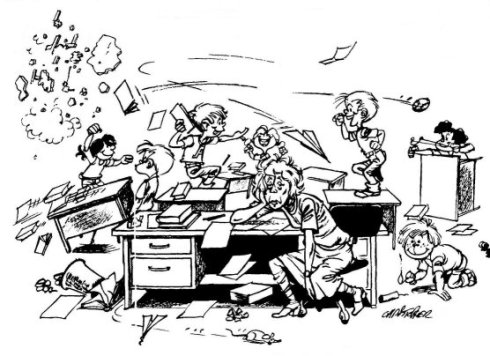
eb2ea15a6abdb8540b4154afa34db796_image-crazy-class-clipart_556-404

Thank you, clip art from Google, for showing me as a small-child teacher

I am, however, a good fit for adult education. Sure, adults can get distracted or talk over other people or mention inappropriate material or take us totally off topic. But they don’t usually throw themselves on the floor while wailing and thrashing around. They don’t randomly start cutting their classmate’s hair with the scissors someone else didn’t put away. They’re not typically found trying to staple anyone’s hand to the desk. They don’t normally start dancing on tables and throwing blocks at people’s heads while you’re busy putting a band-aid on someone’s invisible ouchie (that they insist is extremely painful). They don’t tend to conspire to and carry out a successful prison-level-nothing-to-lose riot while you’re dealing with someone else’s poop. In fact, there is NO poop involved in adult education, which is absolutely one of the reasons I signed up for it.

Unfortunately, however, many of my current students are borderline children, as in 18 year olds who are still living the child role. Many of them come straight from high school to college, and sadly, this college isn’t really different from high school. They are still treated like children. Attendance is mandatory and all-day-long. Their classes are assigned to them and they don’t have any options about when or what, or even who their professor will be. There’s nowhere for them to congregate or get together, and they get shooed away when they hang out together on the library steps or anywhere else outside of a classroom. So perhaps it should be surprising that I don’t have serious toddler-level uprisings in more of my classes.

Luckily, though, it’s just one class I have problems in on a daily basis. But still. It stinks almost as badly as if I were dealing with poop. I turn my back to write on the board and people are flicking each other and smacking each other on the head. A few of the students are constantly hiding this one kid’s backpack when he’s not looking. That’s just a sample. And the talking about anything but English is unabating. “Let’s listen!” I say. “Shhh!” I glare at them. “Let’s respect other people and not talk while they’re talking.” I attempt to reason with them. “Remember? You guys invented our class rules yourselves.” “Guys, we’re in English class,” I try to remind them. “Concentrate. We’re reading right now.” And of course, amidst the ubiquitous play fighting I’m constantly saying, “No violence!” I tell all my students that when they’re messing around with another student. But in this class, between my “no violence” retort and the shushing and concentrating business I’m like the background music on an elevator: ongoing and more common than any other conversation or noise.

“I am not a good authoritarian, guys. Please don’t make me be one.” I tried to level with my class in a last-ditch effort to solve the problem. I gave a speech imploring them to give me other ideas to resolve the problem. “I don’t want to be a strict teacher. I don’t want a silent, obedient class. I want us to have discussions and have fun in class.” The problem, I explained, is that some of the students in this class goof off so much and distract me and everyone else so much that this class is consistently behind my other level 1 class. Which means we do fewer activities. They are less exposed to English, have less practice than my other class. Which isn’t fair to the students who want to learn. It’s not fair to the ones who finish really fast and need extra challenges, and it’s not fair to the ones who are struggling and need extra help from me but who are willing to work hard. I want to keep having lots of group work. I don’t mind their boisterousness at all, as long as they can complete the tasks. But that’s not where they are as a class right now.

It all came to a head two days before my big speech. We were reading aloud, taking turns as a whole class to read and comprehend an article. Suddenly, several students were making comments and rude whistling noises and I don’t even know what other rudeness at the student who was reading, and bam! I started seeing red. “EXCUSE ME?” I asked, belligerently, my eyes bulging out of my head. “Excuse me? Are you making fun of him? Are you serious?” I might have even started pointing my finger all around the room. I was in the teacher version of being that little girl in The Exorcist. “Does anybody in this room speak perfect English? Raise your hand. Anybody?” Some smarty pants said, “You, teacher,” and I was like, “Wrong! I’ve been speaking English my entire life and I can still make mistakes. All of us make mistakes. It’s not only normal, it’s an important part of the process. You all know how I feel about mistakes. They are a vital part of learning. AND you guys all agreed that not making fun of each other is part of what we need to have a good learning environment. Furthermore,” I continued, eyebrows in permnent-raised-mode, “if you’re purpose is to see me mad, this is the way to do it. Disrespect each other some more. If you want me to get mad and get mean and start throwing people out of class, keep up this act. Do you want to make fun of someone else? Make fun of somebody some more? Go ahead and get out of my class right now.” I gestured toward the door.

Nobody moved. It was the first time in my class that everyone was silent for an entire 20 seconds or so. I was still red in the face and sweating. It was not my finest moment in teaching. But people were much nicer through the rest of class.

So I asked them the next day, and explained in a much calmer manner, that some things have to change and that I need their help to do so. That I don’t want to just start imposing new rules and being strict and grumpy all the time. That I want them to tell me how to fix things for everybody. “I get that some of you don’t love English class. I didn’t make this rule about attending, much less about passing English. If you really can’t stand this class, don’t come- but I take no responsibility if you fail.” I talked a little more clearly about the situation as I see it, and what my goals are: to spend less time on discipline and more time on learning. I asked what comments and ideas, and goals of their own they had to share. Nobody spoke. “Okay,” I said, refusing defeat. “Do you need a day to think about it?” Several people nodded. “But do think about it! I’m honestly open to your ideas,” I tried to emphasize.

Sadly, upon follow-up, I got only a couple of ideas, none of which I am stoked about employing. Things like assigned seats. And kicking people out of class for acting up. Those were among the only suggestions. Sigh.

We’ll see what Monday brings. Perhaps some of them, or maybe I, will have had a stroke of genius about how to fix things. Hopefully them. Maybe one of you reading this will shed your brilliant wisdom upon the matter. How do you deal with “discipline?” What do you do when modeling respect is not sufficient, when you lose your cool? All suggestions are welcome and appreciated! Keep teaching, keep learning!

xoxox

Routine and Obscene: Birthing in Oaxaca Part II

12 Apr

Life is messy, and birth is super messy. No matter how you birth, C-section or vaginal, in a pool while listening to jazz or screaming like a banshee at that dumb-ass doctor, it is full of messy body fluids and messy emotions. There is no sterile birth. The whole messy shebang- pregnancy, birth, and the never-ending afterwards is a wild medley of joy and misery for most people. Your body is totally hijacked by this creature and just about everything in life therefore becomes about this creature, which is maddening some of the time even if you had to work hard to get that creature in there. But here’s the thing: it’s still your body, and everybody, every body, every baby, and every body carrying a baby, deserves respect. Period. You deserve respect. You deserve information and you deserve care. No ifs, ands, or buts.

So this is about to be messy, y’all. This is approximately my 18th attempt to finish and publish a blog post about this topic, but I am over-the-top-determined, fired-up and mad and impassioned all over again. So brace yourselves. I am bringing the mess.

Now, let me be clear. I’m about to get very detailed and slightly rabid over doctors, nurses, education, and health care in the state of Oaxaca, Mexico (especially the coast, since that’s where I live.) But that does not mean that this does not apply to you, too, my darling USA. Do not- I repeat, Do Not- go around patting yourself on the back that you’re doing better than Mexico, or that you don’t need to worry about it because you’re safe up there in the North. Do not fool yourself. Mexico learned a lot of these tactics from the US in the first place. The problem is, Mexico ends up scoring higher on the charts at all the wrong things. Soda consumption? Mexico wins! Type 2 Diabetes? Another goal for Mexico. Cesarean births? Mexico is kicking the US’s butt again!

So there are the fews stats I have: “…(T)he maternal mortality rate in Oaxaca is approximately 62 maternal deaths per 100,000 live births, double the national rate,” according to Child Family Health International. The US has about a third of its births via C-section, when the World Health Organization suggests that a C-section is medically necessary about 10-15% of the time. Around here in Oaxaca, it’s hard to get solid statistics*, but it’s estimated that 50% of births terminate in a Cesarean, and that the rate of C-sections is even higher in private clinics, with some estimates at high as 80%. Such a high C-section rate brings much higher risks and worse birth outcomes for both mother and child. And that’s only part of the story of what’s wrong with birthing in Oaxaca.

References: WHO C-Section Statementmortality ratein Spanish, more information about the state of giving birth in Mexicomore info in Spanish, more info on estimated rates  (I am not very familiar with the publisher of the information in Spanish, so I can’t vouch for how definite it is, but it is just about the only information I can find.)

Now, I studied sociology and everything in me is against relying on anecdotal evidence as fact, but in the absence of well-researched statistics, I think anecdotal evidence is worth a mention. This is a big part of what has had me crying and wringing my hands and pumping my fists alternately in these nearly 5 years of living down here- the birth stories that I hear. This is what is going to be my long-term mission to join with others in the community to change, if I end up living here forever: humanizing pregnancy and birth.

It’s ugly in the public sector and it’s ugly in the private sector, but your treatment is drastically worse the poorer you are. In the news there are loads of stories about women who were forced to give birth in the parking lot, on the lawn, in the bathroom, in the waiting room, etc., because there wasn’t enough space for them in the hospital/clinic when they came in. The women that this happens to are always indigenous, but luckily there is no racism here (yes, this is sarcasm). I suppose that’s the worst end of the spectrum, although I’m not sure the care that people receive when you’re admitted qualifies as desirable, either. Yes, it is better than giving birth outside with nothing, but is that really what we’re willing to accept?

What always strikes me as the worst acceptable, routine thing, is that women are giving birth alone. Labor and delivery is one of the hardest and most beautiful and wildest and messiest things you can do in life, and that’s cool if you choose to do it alone. Anytime you give birth in the public sector, though, you have to be alone. All by yourself, with just a bunch of other women around who are also in labor, with not enough doctors and nurses or even, sometimes, enough beds. ALONE! With no one to advocate for you, for your health and wellbeing, for the baby’s health and wellbeing. With no one to hold your hand, to rub your back, to get that hair out of your face, to tell you that you’re doing great and it’ll all be over eventually. Alone! For your entire labor and delivery. Already that, in and of itself, is completely and utterly inhumane to me. I can. not. fathom. it. And it pisses me off extra here in Oaxaca because if you go to the hospital for ANY other reason, they force someone to accompany you. If you have to be recovering from something in the hospital for 3 months, you have to have someone there, just about 24 hours a day, because there aren’t enough resources for the hospital to take good care of you. So why the hell would you send people in to give birth totally on their own?! Heartless bastards! I suspect it’s partially because they don’t want anyone there to defend you and help take care of you.
Let me tell you what kinds of things happen there, while you’re there, contracting and alone. You don’t get any water. I know, many places in the US like to do this too, which is equally senseless and unnecessary, but it’s even more cruel here, where it’s 85 degrees and more humid than Hades. One friend told me that they STILL wouldn’t give her water or food for hours after her birth. Finally she begged a doctor for water and he told her it was at her own risk- as if water was going to do her harm after giving birth!

Furthermore, more than one person has told me that nurses berated them for making too much noise. You’re often in a big room with a ton of beds filled with other laboring women, receiving little attention. One woman just told me that during her birth, they decided that she wasn’t progressing fast enough (normal), but there were no gynecologists in at the time. Therefore she had to wait another 12 hours for the gynecologist to come on call, and then they could only give her a C-section because they decided it was too late to try to speed up her labor any other way (which is a pretty common story in the public sector, due to lack of gynecologists).

Then there are all the excuses they give you to have an unnecessary C-section, especially in the private sector. The cord is wrapped around the baby’s neck. The baby is too big. You’re a couple days past forty weeks. Your hips are too small. You already had one C-section. Ad infinitum.

All of this is similar to stuff they might tell you in the US, but the difference here is that there is no such thing as pregnancy and birth education. There are no child birthing classes. There is no education about what to expect while pregnant even. If you have a doctor like the one I had at the insurance company, they don’t even tell you basic information like when to suspect there is a problem. Culturally, there is no questioning authority. So if the doctor says your baby is too big for you to give birth to, you don’t ask how he or she knows that. You either accept it and get the C-section like they want or you reject the system entirely and go to a midwife, which could or could not be a good option. (More about midwives in another post, I promise- it’s too broad a subject to broach). Many people don’t have the option of midwives, or of anything beyond the very limited bit their health insurance provides.

If you do have the money or borrow the money to give birth elsewhere, it ends up being a similar scenario. The private sector thrives on your ignorance and the total lack of available options, on the fact that almost all the doctors are out to screw you over equally. For example, one prominent gynecologist here told me beforehand that if I didn’t want an automatic episiotomy, that I would have to sign a bunch of consent forms beforehand, and that, you know, it was all at my own risk, because that made it very dangerous! It felt to me like they just make stuff up to sell you more services you desperately “need”- and if it turns out you need a C-section, (which you probably will), then even better, because it’s more convenient and way more money for them. (Multiple people have sworn to me that doctor friends have even admitted this is how they operate.)

On top of treating women like animals in labor, often doctors take the opportunity to abuse their power and your reproductive health and rights while you’re there. The straw that broke the camel’s back in forcing me to finally publish this messy, disorganized blog post about this was hearing ANOTHER story of forced birth control. This story came directly from a doctor who had no reason to make it up. We were talking about IUDs, and how sometimes the strings hang down too short, and he was telling me that he just had a case where a woman had been trying to get pregnant with her second child for years, She had had all kinds of testing done and everything, and they couldn’t figure out what was wrong. Finally, it turned out that she had an IUD in place, that had been put there when she had her first child via C-section, without her consent or knowledge. Apparently this is a common thing- giving women an IUD, either without their knowledge at all, or forcibly without their consent. Another second hand story came to me about a woman getting a forced IUD and the doctor telling her, “I don’t want to see you in here pregnant again for the next few years!” Which I can totally imagine, because that is how doctors talk to people here, especially to women.

Of course they do the same thing with sterilizing women. They pressure you into it if they decide you have enough children. Just this weekend I was chatting about this with someone who experienced it. They tried to force her to get a tubal ligation when she gave birth to her fourth child. “How many children do you have? Don’t you think four is enough?” The doctor tried to shame her. This woman is a total heroin, though- she is the same woman my nurse friend told me about who REFUSED to let the doctor put his hand in her uterus to “clean her out” after birth (another routine, unnecessary, and very painful procedure). She was like, “I came to deliver my baby, not to get surgery, thank you.” She said the doctor wouldn’t leave her alone about it until another doctor who is her neighbor came in and defended her right to decide. Your rights mean nothing. She got to decide because a man in power intervened on her behalf.

I could rattle on and on about more abhorrent stories and accounts, more abuse and lack of rights, but here’s the end game for me: We need more education in the community, AND a total shift in the system. Let’s stop reading about another indigenous woman giving birth on the lawn of IMSS and acting like it doesn’t affect us. Let’s stop listening to each others’ horror stories. It does affect us. It means that we are accepting this as the care that we deserve.  Giving birth is messy but it shouldn’t be dehumanizing. Being routine does not make something acceptable.

Can Hot Dogs Make You More American? Thoughts on Assimilation

26 Mar

The immigrants in this country are not a very assimilated group. They stick out at first glance, with their differently colored skin, distinctive height, and other such physical features. I guess it’s not polite to talk about the physical things they can’t change, though.

It doesn’t stop there, however. Half of them don’t even seem to try to speak the language. Even the ones that do try to learn often speak it incorrectly, or with an accent that makes it difficult to understand. They tend to cluster together, too, living in the same few areas of town. They frequent businesses owned by other foreigners, speaking their foreign languages, eating their foreign foods, buying their imported items. It’s preventing them from becoming patriotic, assimilated citizens.

Many of these foreigners don’t have their immigration paperwork in order, either. Some of them come in and out of the country every few months on tourists visas, even though they’re living here, sometimes working under the table, and that is breaking the law! Sure, some of these people have married citizens or have children who are citizens, but who’s to say that they’re not just using that as a way to get their papers?

Worse than that, right here in this city, these foreigners are taking the best national resources for themselves. The areas of town where they crowd together are nice areas, where some good, legal citizen could be living instead. Many of them have high-paying jobs, which, once again, could be going to citizens. Many of them aren’t even contributing properly to the economy and paying taxes; instead they are doing work online or running some overseas business, thus bypassing the local economy.

There is no uproar here about this immigration problem, however, because this is Mexico, and these immigrants are white. Because racism is alive and well all over the globe in different forms, and yet it is never discrimination against white people, even when they are the minority, even when they do the exact same things that black and brown people suffer for.

So I walk around unsanctioned, speaking only English to my children, trusting that they will learn Spanish sufficiently in school and in society at large. When people do comment about it, they are curious or encouraging, not aggressive and hateful. I speak Spanish pretty well, but even after more than a decade of practice, I make mistakes. I go to work at a decent-paying job, where my job is held exclusively for foreigners. Nobody questions my right to be there. When I first moved here, I came on a tourist visa, because I hadn’t yet been able to figure out how to get a visa to live here, until months after I’d moved here. And when I did finally go to the right authorities for my immigration paperwork, they were incredibly helpful, and I was entitled to a lot of things just by virtue of having a child with Mexican citizenship. (Plus the immigration officials here are so nice they are saint-like, which is not the typical experience in my country). Being a white immigrant here is a similar story to what white people in rich nations decry: not assimilating. Except nobody is denouncing the white immigrants here, or anywhere else.

(For example, this article points out that there are an estimated 50,000 Irish immigrants in the US who don’t have their paperwork in order, and yet they’re not being targeted for deportation. More evidence that the real goal is to make the country whiter.)


salsa

Are you an assimilated immigrant in Mexico when you know how to make good salsa? Are you assimilated in the US when you can grill hot dogs? Who gets to define this stuff, anyway?

So you can imagine my dismay when I was reading about a bill being proposed in the US to limit the number of legal immigrants coming into the US. Of course this might have personal repercussions for my family, potential reducing the chances of my husband getting a visa. Beyond being worried about that, though, I was struck dumb when I read one explanation of the reasoning behind it:

“In the House of Representatives, Rep. Lamar Smith, R-Texas, expects to propose a companion bill to reduce immigration. He is concerned about immigrant enclaves growing in metropolitan areas.  ‘When you have so many immigrants being admitted, they tend to cluster together, they tend to maybe be a bit more slow in learning the English language, to becoming acculturated, to becoming patriotic Americans,’ Smith says.” (from this article from National Public Radio)

First I was pissed because he should have said “be slower” and not “more slow” (or said learn more slowly, if that’s how he wanted to say it). If you’re going to talk smack about other people learning your language, then you better have perfect grammar and diction yourself, fool. Secondly, I bet you a million dollars he has not learned any other languages and has no clue what it takes. (Plus many immigrants already speak English, too, but obviously these “representatives” of ours do not give a damn about facts.)

So, okay, maybe I’m being petty about the language thing. What about the whole humanity aspect? Let’s say I’m not overreacting. Let’s say it’s just exactly what he says. Let’s pretend he’s even worried about immigrants’ well-being. He wants them to speak the national language so they have equal access to all that the US has to offer. How is limiting the number of immigrants coming into the country going to help people learn English and culturally adapt? Is the reasoning that if they feel more isolated and set apart, they will become more patriotic? I know; perhaps the theory is that they will be forced to learn English faster if they don’t know anybody who speaks their language. So does that mean that we will also be putting caps on how many immigrants who speak the same language can be in one city, just to make sure they don’t meet up and speak their language too much? Should we limit how many immigrants are in one neighborhood? Bar foreign languages from the street? Is that where he’s heading with this? Because limiting the number of new legal immigrants to the country, especially when you’re preventing people’s husbands, wives, children, and mothers from coming in, is not going to teach people better English.

If the goal were actually to help new immigrants speak English and be a more integral, connected part of US society, there are ways to go about that. (Why, why, why does my country not use any of the research about ANYTHING?!?! Why do we even have research, people?) For example, my favorite librarian holds English practice exchanges, where English speakers (citizens, immigrants who are fluent, etc.) pair up with English language learners for conversation and camaraderie every week. I suspect that helps people learn English and feel like they’re part of our fabulous community much more than potentially denying entry to people’s family members- because, sorry, we’ve reached our limit for this year. Let’s be honest. Legislative actions like these are not about helping immigrants, or about keeping us safe. It’s not about having a more unified-yet-non-homogenous country. It’s about having a more homogenous, whiter country. It’s about keeping out more of the “different” people.

Not only is his opinion full of hypocrisy and racism, but it also reflects an utter lack of empathy. I suspect he is as clueless about being uprooted (willingly or not) as he is about language learning.

He obviously doesn’t fathom what it’s like to long for pieces of home. To need to express something that’s deep in your spirit, and not have the right words in your adopted language. To feel your heart soar with a certain song and not have anyone to share it with. To crave certain fruits or certain dishes so desperately that nothing you eat tastes good for weeks on end.

He doesn’t understand anything about needing someone to recognize you. How there are completely trivial things that become crucial, because the need for recognition, understanding, and acceptance is essential. For me, this translates into things like wishing that someday I could just go out and purchase biscuits and gravy, instead of taking all the time to make it myself. It means that every winter I cry at some point because I might never eat my mama’s chili on a cold night again. It means that even if there’s karaoke in English, no one will understand the irony in my song choice. (Nevermind that I only used to do karaoke like once a year.) It means there’s no place to publicly dance in my style, to my kind of music. It means that I would kill for a group of people to play spades with. (Nevermind that it’s just a card game. This is life! This is me!) I’ll even admit that now I have even watched the Kentucky Derby, out of sheer nostalgia, although I never cared when I was there and I’m even a bit ethically opposed to horse racing. (Don’t worry, though, I don’t want to eat Kentucky Fried Chicken or anything else that absurdly unlike me. I want home comforts and a context for my identity, not cheap grease with my state’s name on it.)

When you live far away from where you became you, there are certain things that you need to be your security blanket. You’re putting down your roots somewhere else, and the sun will still shine to nourish you, but even plants grow better in good company. Anybody who’s ever been outside of their comfort zone knows that your soul needs bits and pieces from home to keep yourself in perspective when you’re in a different context. This is my truth, and this is the reason that all immigrants need some quality time with folks from their country- and preferably folks from their region, and even better if it’s family. Everyone needs recognition, even (especially) immigrants and refugees.

So let’s not use immigrant communities and languages as an excuse to further a white surpremist agenda, please and thank you. Let’s call out racism for what it is, and instead work to build bridges between our cultures and languages. If you’re in Louisville, Kentucky, you can even pop on down to the library to share and get to know your community better. And if you are in Puerto Escondido and you know how to play spades (or want to learn), please come find me!


P.S . Please note I am not against folks who travel or live somewhere and don’t know the language or don’t otherwise “assimilate.” Everyone has their own reasons and their own process.I am not against white people in my adopted city, either, obviously, although I am very against hypocrisy and racism. I am not saying the description above fits all foreigners in this area (just like there is no uniform immigrant experience in the US), but it truly is the case here that white folks are doing the exact same things that black and brown immigrants do in other places, but in the US and elsewhere they get not just criticized, but also threatened, beaten, deported, and killed over it. Reverse racism does not exist!

A Flawless Foray into the Big City

17 Mar


Perhaps both children vomiting all over themselves in the car doesn’t sound like an auspicious beginning to an utterly delightful outing. Obviously, then, you’ve never voyaged upon the seven-plus hours of winding, two-lane “highway” between Puerto Escondido and Oaxaca City. You have no idea how bad it could have been.

Because Conan was scheduled to work on Saturday and Sunday, I originally decided I would go up in the public vans on Friday night. The last time we made this trek, when Khalil was two months old, we’d gone in a van at night and everyone had survived. Conan slept through it all that time (while I was covered in children, not sleeping), so I was sure I could do it alone. Apparently, however, I underestimated the chances of my kids waking up to vomit. So just imagine! I have been in the public vans plenty with puking children (mostly not my children), and let me tell you, half the time that driver doesn’t even slow down. It could have been so, so ugly.

But it wasn’t! Because Conan got someone to work for him on Sunday and we have a car that actually does car-like things, such as take you places. The miracles abound! So there we were, over four years in to living here, finally in our very own private transportation for this billionth trip to Oaxaca. We got baby vomit on our very own car seats at last!!!

Additionally in the “dodging bullets- aka winning” section of events, I narrowly avoided meeting a long-last family member of Conan’s when he realized we were in their neighborhood in Oaxaca City. Don’t get me wrong; meeting new in-laws is normally a rollercoaster I can ride. However, at midnight, when your eyes feel like they’re glued semi-shut and your mouth is dry like 3 day old tortillas and you’ve been in a car for 8 hours and you’re drowsy on Dramamine and your children still reek of vomit and darling, these relatives are not even expecting us– that’s not even a rollercoaster, it’s just a train wreck tale in the making.

So we continued on to our dear friends’ house, where they were totally expecting sleepy, confused, slightly smelly guests at midnight. We are so lucky to have adoring friends-turned-family who graciously accept us and our pukey children at any hour of the night with open arms and smiles. We are so ridiculously privileged to live in Oaxaca, where guests are synonymous with royalty. Our hosts greeted us lovingly, chatted for a few minutes, and left us to rest in their comfy bed. These folks are the reason I always rule out doing our bureaucratic business in Mexico City. Even as I washed vomit out of car seats the next day, I thought, “Airplanes are fun, but there’s no Argelia and Magaly in Mexico City. Totally not worth it.”

IMG-20170311-WA0000[1]

When we asked Lucia later what she liked the best about the trip, she replied, “When we ate the broccoli at Arge’s house.” Since we eat broccoli once a week at our house, and I cooked the broccoli like I do at home regularly, I have no idea why this was wondrous for her. Children are a mysterious species. Apparently Oaxaca City made a serious impression on her this time, though, because she nonchalantly told my mother-in-law later that she’s planning to move to Oaxaca. She refrained from specifying a date, so I can only speculate about her intentions.

My favorite part of the trip, in contrast, was when we did something novel. I liked it when we went to an actual park with more than three trees, and with a gorgeous view of the valley that is Oaxaca City. I loved the swings hanging from trees, swings made out of slats of wood. I loved our easy feast of quesadillas, cucumber, and watermelon.

I loved that the non-parent-people in our group didn’t get mad or upset when we didn’t do the two mile hike that we originally mentioned (ummm that was never, ever going to come to fruition with the little people). I loved that when my about-to-turn-two-year-old resolutely and rapidly took off his diaper and shook his two year old penis at the sky before peeing, all the other families thought it was funny and endearing. Nobody called the police or child protective services on my child and his rebelliously naked butt. (Granted, it was temporary nudity, but still.)

I loved loved loved fulfilling my new self-imposed obligation to seize all interesting opportunities, to try all the new things. (I’d like to thank the current political climate and brilliant author Shonda Rhimes!) It helps that our friends are so open-spirited, too. “What’s that?” I asked when I saw the zipline, “And how much does it cost?” Instantly, Argelia was already grabbing me by the elbow and leading me to the action. Magaly agreed to be the fearless distraction expert for the little ones. Arge volunteered to be our fearless leader and slide herself over the cliff first, since she’d done it before somewhere else. She wasn’t actually fearless, though; it took a little coaxing to get her to push herself out into the abyss. Even when you’ve decided to be fearless, that shit just creeps back up on you. I had to hold my breath and close my eyes, too, to convince myself. It was, in fact, really fun, and I’ll absolutely be doing it again the next chance I get!

Here we go:

 IMG_20170226_152438[1]

IMG_20170226_153145[1]

You can just barely see Arge zipping across there.

To top off a perfectly fabulous day, we finished things off by drinking beers (those of us who drink) and (gasp) playing cards! More of my favorite things!!!! Can life get any better? I suspect not.

While playing cards, we discussed the fact that this kind of fun doesn’t happen among women in small towns. Argelia is certainly not a small town girl in spirit. She’s petite but packed with a giant personality that couldn’t really fit into her tiny mountain town. Now Argelia plays cards and drinks beer, and can even play a little pool, but only thanks to all these years in Oaxaca City and Magaly’s wonderful influence and big-city girl privilege. Magaly is from Mexico City originally. I knows she’s from a big city because she knows how to do all the things the girls from small towns almost never learn. Magaly knows how to play pool. She knows how to play cards. She knows how to drive a car. She knows how to drive a motorcycle. She knows how to ride a bicycle. She likes to drink beer for fun. She was allowed to have all kinds of fun in life. I’d bet money that she knows how to play a musical instrument, too, although I forgot to ask her. Granted, it’s not that all of those things are expressly forbidden to girls in small towns. They just tend to not happen, if you want to put it in apolitical terms.

The next day was dedicated to bureaucracy and travel (aka destined for disaster). And yet it was nowhere near as disastrous as it has been in the past. I didn’t spend hours crying and agonizing over how to “forge” my own signature, for starters. Our friends whisked my mischievous two year old away to have fun outside of the consular office. The (woman) security guard was ridiculously nice, telling me that I did, indeed, have time to hurry and guzzle a coffee downstairs, just when my caffeine downer threatened to knock me out right there in the back row of hard plastic chairs. Once our turn came, it turned out that we had successfully brought the right-sized photo and all the other correct paperwork. There were no excessive questions, not even dirty looks. When the in-charge person asked about one document that looked slightly dodgy, and I shrugged and affirmed that that’s precisely how it came from the dodgy organization known as my insurance company, she accepted it without further ado. It was, by far, the least stressful passport situation we’ve dealt with thus far, considering our ridiculous number of visits and renewals and such for this multi-nationality family.

The adults in our group had started having mini-meltdowns  from hunger by the time we were finished with our obligations, but we made it to a restaurant before any violence broke out. We forgot the childrens’ balloons that Arge and Magaly bought them, but there was only a small panic attack on Lucia’s part, and we hoped that some other kids found them later.

For the trip home, I got smart and got the Dramamine for Kids. Khalil vomited his dose about 10 seconds after taking it, which was totally best case scenario! I had zero doubts about re-dosing him, plus the puke was only on his pajamas and Arge’s floor, allowing for relatively easy clean-up. Another win for our trip! Additionally, nobody puked in the car. Our car delivered us to our door without breaking down or even making new, worrisome noises (thank you, Conan, for being the fearless driver)! A good time was had by all!

May all our future outings, and yours, be as optimal as this one!

Decision-Making for Dummies

22 Feb

Is paper/rock/scissors a valid decision-making method? Since I’m trying to make a gigantic, life-altering decision, obviously I would do best two out of three. Or perhaps I need a Tarot card reading. Or I could pose the question to all my Facebook friends, and go by whatever option gets the most votes. I might write each decision on opposite sides of the room, spin around until dizzy, and then point with my eyes still closed. Similarly, I continue to contemplate getting wasted drunk and writing a note to myself about what feels the most right, with all the hidden insight that excessive alcohol might bring out.

And these are just my better ideas.

Seriously, I cannot make this decision. I won’t do it and you can’t make me! I want to shout at the universe, complete with a stern pout and possible foot-stomping or middle-finger-flying. It’s too big a decision, it affects other important people too much, and it’s all on my shoulders, for better or for worse. I’m not gonna! (I’m sticking my tongue out at y’all, now, too, moon and stars and everybody.) The recovering perfectionist in me is pissed because there is no “right” answer. The anxiety monster in me is terrified because there are major negative consequences on both sides, but which negative consequences will be worse- and for whom? If I make this decision and the worst happens, it’ll be all my fault and no one will ever forgive me and I won’t even be able to live with myself- assuming I’m still alive after the worst. Oh, hell, no, y’all, I am not taking responsibility for this. No, siree. I’ll just wait for a definitive sign from the heavens first, thanks.

Except I have to decide. Even if I pick the default option of doing nothing, that’s still a decision that I will then have to live with, with all the positive and negative consequences that entails. And there are consequences for my whole family. Ugh! Part of me, of course, recognizes that I am ridiculously privileged to even have options, despite them not being exactly the options I’d like. Who the hell gets all the options they want in life? Nobody I know, and probably nobody I care to know. So I think about other folks with trickier and much more dire choices- or lack of choices- and I shame myself for bemoaning the fact that I have to / get to make a decision in life. Unfortunately, the shame doesn’t actually change anybody’s situation or help me make a decision. So here we are.

I have a deadline. It’s almost here. I don’t want to say the date out loud, because then it will be more real. But it’s very, very soon. (Shiver and shake!)

Because apparently, life requires some modicum of planning, and institutions like schools and jobs and banks always want to know whether you will be utilizing their services or not in the coming cycle. Those nosy bastards. Then there are the other folks, close friends and family, who also insist that your most major life choices affect them. They’d like to plan accordingly, they say. And yet they refuse to take the decision off of your hands. Selfish, selfish, selfish!

Instead of deciding for me, loved ones give me sage advice. For example, a dear friend encouraged me to listen to my heart. The problems with that are that a) my heart is divided in multiple directions, and b) my heart usually leads me down the most difficult and dangerous path available. That certainly hasn’t been exclusively awful; as a matter of fact, I’m pretty damn pleased about many of the outrageous decisions I’ve made. Once I’ve made a decision, once I’ve survived some of the results, I get very zen about it all, magically. This is forming and growing me as a person, and all that. Even the decisions I made that, in hindsight, were excessively foolhardy and ill-advised, I can shrug my shoulders and toss it into the pile of “makes for a great story fodder.” I am the main character in my life’s novel, right?

(Joyful Girl, by Ani DiFranco, is one of my anthems since adolecense that encourages this philosophy for me: “The bathroom mirror has not budged. The woman who lives there can tell the truth from the stuff they say. She looks me in the eye, says, Do you prefer the easy way? No? Well then, okay, don’t cry.”)

But I feel a distinct lack of zen now that there are small children involved. These little humans are counting on me to not ruin their lives. So the question then becomes, which path will ruin their lives less? (They’re gonna need therapy either way, as my dad would say.) But how can I calculate the least-harm scenario? There are short-term and long-term effects for them, but most of the long-term effects are potential effects. There’s a whole bundle of maybes in all my equations, which is yet another reason why I’m not a great mathematician nor decision-maker.

So if the short term effects for them are fairly negative, and then the hopefully excellent long term effects go all awry, then I will have made the wrong decision, right? Alternately, if the short term effects are mostly positive, and the long-term effects don’t have much room for astounding but might not be abysmal, either, does that mean that’s the right choice? Either way, super-duper disasterous things can happen! And where do my needs and desires, and my life partner’s needs and desires, all fit into this? What about the If Mama Ain’t Happy Ain’t Nobody Happy effect? How much and in what way does that count in this? Where is my text book? Where is my tutor? It’s like you just learned to do division and then they throw some complicated thing into mix, something like, I don’t know, exponential numbers. And the teacher doesn’t explain worth a damn in the first place; they’re just throwing random numbers crap at you, so how can anyone expect you to ever solve this problem?!

My perceptive and astute therapist mother reminded me to “use wise mind” as my guide. Wise mind, theoretically, is that brilliant and perhaps fictional combo of emotional mind and rational mind.

Here’s a little visual about “wise mind” for all you visual learners out there. I acquired this image from this site.

tumblr_nfgeqvqqfu1tluyh7o1_500

Does wise mind exist in me? Hmmmph! Sure, I guess it’s in there somewhere, since I can do both rational or emotional exceptionally well. But blending them? Quieting my anxiety and ceasing to analyze long enough to listen to the deeper part of my being? Ha. When? Between my full-time paying job and my full-time mother job and my full-time housekeeper/cook job, I’m pretty booked. Ain’t no space left in my calendar for an appointment with wise mind.

Maybe that’s an excuse, though. I mean, really I know what path I want to walk. I already know, because I know exactly who I am and what I want to do with myself in this one little life. I know what my values are. I know what I have to contribute to a community. I know what decision I think will put me in a position to live more in line with those values and let me contribute to the universe best. I already know.

But as soon as I say that, my raging, roaring bear named Anxiety rears up on its haunches and yells, “What if you’re wrong, though? How do you know that you’ll be able to live your purpose in life on this path? Maybe you can find your purpose on this other path just as well. You just need to look harder.”  Then I get new information that kicks rational mind back in to gear, like a know-it-all-doctor from the 50s calmly blowing smoke in my face, telling me I need this treatment for my hysteria. “Look at these facts,” that jerk says.  “This is a bad time. All of the evidence points to disaster.”

Back and forth I go, several times a day. Every day I debate and deliberate, tying my stomach in viscious knots, winding myself up like wind-up doll, and waiting to see what decision I’ll have made when the coil stretches. Every day I dream of somebody coming to take this weight off my shoulders, of someone telling me the decisively “right” thing to do. Except I’d probably STILL find some reason to keep arguing about it. “But read this study first!” I imagine I’d say.

I suspect that either way, it’s gonna be ugly and it’s gonna be lovely. No matter which path I take, I’m doing somebody wrong. All concerned parties are going to have some negative consequences. No matter which path I take, there will be some negatives and some positives and ultimately I cannot predict what they will be or how wonderfully joyous or horrendously grave life might be in the future. Which is probably a truth about the Whole of Life every single day, we’re just not usually as hyper-conscious of it as I am right now with this blasted decision.

Meanwhile, the deadline looms. Weigh in on your decision-making advice, before it’s too late and I decide to just flip a coin!! Seriously, folks, I don’t ask for advice every day; now is your chance to give me your best decision-making guide.


Visitors’ Views

15 Feb

Finally, oh finally, we got our yearly visitors! First my stepmom, Karen, came- her first solo trek since my dad passed away, which made it a whole ‘nuther kind of new. Then my mom and her partner Dee arrived, this time with Dee’s son Andy, for his very first escape from Gringolandia.

There were many wondrous moments brought on by these visits, which I may or may not share with you in some future blog post. For now I will share with you some astute observations from my fantastic, fabulous family.

Okay, I will also tell you that Karen and I got to have grown-up time and took fantastically fun photos :

And that my mama and I destroyed Conan and Andy in spades!! (No pics, sorry.) Now on to our next portion, observations from all my glorious visitors:


“Desexualized” Swimming

While Zicatela beach is world-famous for its giant waves for surfing, it is not where anyone wants to take their children to swim. There are two other sections of beach with much calmer waters- one, Puerto Angelito, being the most preferred. (We had our annual all-family-mixer there again, complete with oysters just pulled from the sea, as usual. I got out of control and bought three kinds of cake so we could celebrate everyone’s birthday this year.)

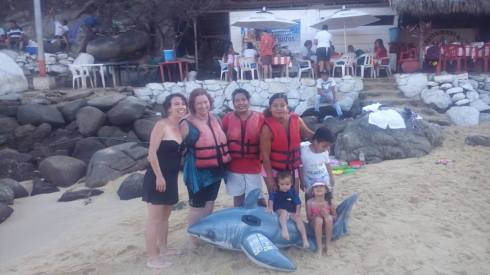
In general around here, the beach is not spring break in Florida. There are not gobs of young women laying out in bikinis. Yes, bikinis are popular beachwear here, for folks with all sizes of bodies. Yes, some people sunbathe. But particularly at the swimming beach, people aren’t hanging out trying to look sexy. They’re just swimming. Or eating. Or having a beer. Or playing in the sand with their kids. Some people wear bikinis, some don’t. Many people don’t even wear official swimming gear. Lots of people, even folks who live here, don’t own a real bathing suit. Plus you get some folks stopping by on their way somewhere else (especially pilgrims going to or from their visit with the Virgin of Juquila) who weren’t really prepared to go to the beach. So there are people in jeans and t-shirts. There are people in other thrown-together swimwear. Nobody cares what other people are wearing or doing, as seen below.

16425758_10208281914393238_8741692092338185000_n

the swimming beach

16472893_203381853469914_3123678742937684197_n

A lotta people I love. Only my kids and I are in official swimwear. Check out the folks in the background, too.

16508304_10208281920753397_5824004524049054688_n

foreground: my monsters with their sweet cousin. background: NOT spring break in Palm City Beach or whatever it’s called

Use of Public Spaces

“People use all the public space. People are much more present in public.” These were some important observations from Andy. “You can even lie down on the floor of the airport and nobody even looks at you,” he said.

People are constantly out in the street- on their way somewhere, chatting in the neighborhood, watering the garden, sitting on the stoop of some business to share a beer (well, men only on this one). Here it doesn’t matter if there are no sidewalks- people walk anyway, because that’s how most of us get around, at least some of the time. Thanks to there being fewer cars and there being a small corner store on every 3rd corner of residential areas, there’s always somewhere to walk to.

Pertinent to that, ideas about the public and private are radically different here. The public space is where many social events happen, rather than in a private home. People that aren’t family don’t usually just drop by your house and come on in, either. They (usually) stay in whatever outside area or public-ish open area you have, even if it’s a woman visiting another woman. I almost cried tears of joy last year when a friend came and visited us and sat in my bedroom with me, so I could play with Lucia on the bed AND talk to her at the same time (not be excluded from the social, adult world despite my parenting responsibilities in the private, off-limits realm of my bedroom). I had missed that kind of assumed intimacy, that consensual sharing of privacy that we’re into in the US.

I think that using public space more and private space less has some advantages, especially in that you don’t need a fancy home to have social time. However, I think that it gives women an automatic disadvantage at social life outside of their family. Women (pretty much universally) have more domestic responsibilities than men, and tend to spend more time at home because of it. But when your home is not a place for socializing, that means that you can’t socially multitask, like I used to do so much of the time- inviting your friends over to chat and washing your dishes while you do so, for example. Changing the baby’s diaper with your girlfriends in the US means they accompany you to whatever room so you can keep talking. In my personal experience here, that’s not the case. So this public/private cultural difference is a funny juxtaposition because on one hand, everyone being out in public, using the public space is so much more open and accessible, but it’s also less intimate in a different kind of way.

(Apparently I was dying to elaborate on this observation!)

Nature Like We Don’t Get At Home

Seeing iguanas everywhere is STILL fun for me, years later, so you can imagine how cool it is for other folks. I still giggle everytime I’m teaching class and a big ones falls from a tree with a giant clunk. For some reason, though, nobody was very excited to go see crocodiles in a lagoon, once they discovered it wasn’t a behind-the-glass, zoo-like experience. What? You don’t want to see crocodiles next to you in a small paddle boat? (Don’t worry; I was planning on leaving the kids at home for that outing.)

I didn’t even tell Andy about the scorpions, like the one that was strolling all nonchalant across my kids’ bedroom floor one evening last week. Good thing my kids never sleep in their own beds, huh?

16473866_10208290456406783_6800881647283940608_n Pictured: Our major nature adventure to the botanical gardens (obviously, it’s dry season). Andy was not thrilled to learn about the local venomous snakes and potential mountain lions around, but he braved the hike anyway.

16427715_10208290455726766_1807321232749987649_n

The Dogs Run The Streets 

Dogs around here own the streets- both strays and many pets are out running around all day and night. (Pets here are not treated like spoiled children, for better or for worse.) There’s no animal control and not a lot of campaigns to help people spay and neuter, so lots of dogs end up sad and hungry. Karen, a hardcore champion of all animals, bought a bag of dog food to carry around to feed poor, starving stray dogs, like the ones she saw in the mostly-touristy beach areas her past couple of visits. She was pleasantly surprised, however, to find a street full of lazy, chunky mutts. The business owners and residents of the neighborhood where she stayed are economically well-off enough and animal-loving enough to make a little doggie paradise, in one neighborhood at least.

Never-ending Resourcefulness 

Despite very high rates of economic poverty, folks here are ingenious. They come up with solutions for everything, as I’ve raved about before. There aren’t many people asking for change on the street, but there is lots and lots of hustling to make a living, working in the street, selling candy, popcorn, toys, juice, or washing windows or whatever. Andy didn’t even see the door-to-door salespeople walking the dusty streets to sell furniture that they are carrying on their backs, and even so, people’s resourcefulness and perseverance made an impression on him.

No “Essential” Electrical Apparatus

Both Karen and Andy were taken aback by the lack of microwaves. “When you said you were warming up beans for the kids, and then you came out to get Khalil and ran back in yelling about your beans burning, I was kinda confused for a minute,” Andy joked. Karen thought her hotel’s kitchen area was well set up but was definitely missing a microwave and coffeemaker (another electrical appliance that is far from universal down here). A microwave is just not the kind of bare necessity that it is in the US. Mostly corner stores have them if they want to sell microwave popcorn and soup-cup Ramen noodles. My mother in law has one because she used to sell that stuff, although nowadays she only uses her microwave as a storage space for bread, or as an emergency cooking device if her stove runs out of gas and she doesn’t have the money then for a new propane tank.

Also missing in action here: toasters, clothes dryers (it is in the 80s or 90s everyday here, although even in cold and wet places dryers are not “a thing.”)

OLYMPUS DIGITAL CAMERA

Mexican toaster- aka comal – not my photo! from FeralKitchen.com

Go, go, go

Everywhere you go, people are walking, riding bicycles, riding scooters and motorcycles, riding ATVs, riding buses, taking shared cabs called colectivos, hailing taxis, and just generally getting around one way and another. Not everyone has a car, to say the least, but there are way more options for transport. Public transportation is more common and more user-friendly than any small city or large town I’ve ever been to in the states.

Andy asked, “How does a country that’s poorer than the United States make it easier for people to get around?” This is a question that everyone in the US should be asking themselves and then asking their community and their elected officials. This question, and so many others like it, also represents to me why travel abroad* is such an eye-opening, heart-reconstructing, mind-altering, life-metamorphasing experience: you shift your paradigms of both the normal and the possible. You shatter stereotypes. You see new things that don’t work for people and new things that do work for people. You question your home culture as much as the culture you’re visiting. It’s a win-win situation for the world and you.

Keep travelling, even if you can’t leave home! Keep loving, at home and abroad!


*I know not everyone can physically travel to another country. Having friendships with folks from a different country, reading foreign books, even watching many foreign movies has similarly altered my consciousness and my heart for the better. It’s a global world; take advantage!

visit-2

Attempts to capture the moment with my mama and these random small children I found on the street bwahahaha

Bilingual Baby Speak, Take Two

26 Jan

Supposedly it’s common for kids growing up in multilingual environments to take more time to talk. Whether that’s the reason or not, my littler little one is definitely a case study in resisting the grown-ups’ languages. Rapidly approaching age 2, young Khalil still only has about a 6 word vocabulary. But he sure can get all his relevant points across with his limited lexicon.

“M” words are at the top of his list, since they include all the things necessary for his survival: more (duh- more everything, please), ma (meaning both “my” and “mine,” always accompanied by pointing to or beating on his chest), and mum (mama, but apparently he’s part Irish like his Papi* and prefers mum).

For instance, when I caught him drinking honey out of the jar this morning, he didn’t even look guilty; instead he blithely asked for more, since the jar was now empty.

When he heard me talking on the other side of the door at his preschool, he B-lined for the door, which I deduced because I heard a clear and steady stream of “Mum…. Mum…. Mum…. Mum…” Then I heard his teacher ask, “Where are you going, Khalil?” to which he replied, of course, “Mum.” When he sees something that he knows is only for Mommy and Papi to touch, he goes “Mum,” and then shakes his head and points to himself. When he sees a beer can? “Mum.” That’s right, kiddo, that’s right. When Papi comes home? Also “Mum.” Until Khalil makes it to the P sound, Papi gets to be the other Mommy.

img_20170126_145549_3cs1

These are ma delicious fingers, thank you, says Khalil

The only word that he says in Spanish so far is “uno.” He uses it to count, of course. When we do his asthma inhaler, I count and he also counts, except his counting sounds like this: “uno, uno, uno, uno, uno….” He also uses the word uno to indicate a garafon (big water jug) truck, or anything else he finds interesting that there is one of. A dump truck? UNO!! A bird? UNO! A piece of candy? UNO! (accompanied by ma! and chest beating) Conan has invented his own game for this, which goes something like this: “Khalil, how many Mommys are there?” Khalil: “Uno!” “How many cats in the house?” (Etc.) Khalil has a good concept of mathematics, too. If there are two dump trucks he’ll say “uno” and “more.” And when a whole flock of birds flies into the sky? Latalatalatalata (which we interpret as a lot of a lots: alotalotalotalot)

img_20170109_0758081

UNO!

He’s working on the b sound, since that also contains some favorites. He attempts to say bread and bird and book, although none of them are clear out of context. He makes a grunting noise that starts when the b sound to mean big, which is one of my favorite semi-words of his.

He added two words in one week recently, and for a second there, I thought we must be headed for rapid progress in language development. Turns out, though, he was just really inspired by these two things, because no further words have been added in the weeks since. One of the inspirations is the word Elmo, although I didn’t even realize that he had a clue who Elmo was, since Khalil has zero attention span for videos (I’m not complaining, don’t worry). But he found a pair of Lucia’s old Elmo underwear and was ecstatic, and emphatic about the word Elmo. Now even the Cookie Monster towel is Elmo and it is his exclusive property, thank you.

Equally as emphatic and clear, he also added the word “vulva” to his vocabulary that week. And in case you thought it might have been a mistake, don’t fool yourself. He started using it at bath time, one night that the three of us were bathing at the same time (them in a tub, me in the shower). He pointed at mine and said, “vulva.” He pointed at Lucia’s and said, “vulva.” And finally, he pointed at his own genitals and said, “vulva.” I tried to tell him that his had a different name, but he is pretty determined to also call his a vulva, so I’ve decided it’s best just to go with it for now. Of course it’s become a torture technique for Lucia, to taunt Khalil, singing, “You don’t have a vulva! You have a penis!” And Khalil grabs his and goes, “Vulva!” And Lucia repeats her taunt, ad nauseam until I break up the fight. Leave it to my kid to be a 6 word wonder who uses the word vulva on the daily. So fitting.

And really Elmo and vulva are basically the same in both languages, so perhaps I can count that as four words, as a Spanish part  and an English part of his bilingual lexicon.

If you count animal sounds as words, then we can double his toddler terminology. He’s particularly fond of owls, apparently, because two of his cloth diapers have owls on them and just about every time I change his diaper he goes, “whoowhoo.” He can also howl at the moon to indicate a wolf. Oh and I forgot he can say “moon”- another m word not as obviously imperative as his mum, but pretty darned important (particularly for howling purposes). Because he can say moon, obviously he can moo like a cow just as well as Elsie herself. He makes a sad little whiney meow when he’s imitating a cat- possibly because he’s always abusing our cat- pulling her tail or petting her so forcefully it’s essentially hitting. “Baa” is a classic of his, since we have goats and sheep around our neighborhood. “Baa” is his go-to phone conversation, so much so that Lucia coaches him when he’s talking to one of the grandparents. “Say ‘ba,’ Khalil,” she suggests, and he does. I can sense his building up to the rooster sound, because he bangs on the door in the morning till I open it up so he can observe our neighbor’s rooster come pecking around and crowing. He can’t say “neigh” yet either, but he gallops on the broom really well.

Despite his rather meager vocabulary, this is one communicative child. Uninterested in television, he can video-chat play with my mom for like 30 minutes, while my four year old is only interested for about 5 minutes.  He tells me about the things that have happened in his day, between sounds and demonstrations. He reenacts falls and other mishaps like a natural thespian. When he wants food, he says, “yum” and pretends to put something in his mouth, or else he goes and bangs on the fridge door until you open it and he shows you exactly what he wants.

He shakes his head and/or wags his finger at everything that’s a no. This “no” technique is especially useful in letting you know what’s not for you or to make comparisons. Like he’ll point to his Elmo underwear and say, “Elmo. Ma.” Then he’ll point to your underwear region and shake his head no and say, “Elmo,” until you confirm that indeed, his underwear has Elmo and yours does not. His shirt has a shark and yours does not. He even jokes with his “no” game. That’s his potty and not yours. No, Mommy, that’s his sweet big belly, not yours. Those are his 7 bananas and none are for you. That coffee is his and… No? He’ll smile slyly when he knows it’s not his. The kid can even joke without using real words!

What more could any kid really need to say? Language is for the birds! And wolves and goats, too.


*Sorry, inside joke. I’ll leave you wondering whether he’s really Irish or not. Bwahahaha.