“Authentic” Mexican Recipes- Southern Oaxaca Style

27 Jul

There ain’t no chimichangas around here, as Conan would be the first to tell you. There are no burritos, either, nor do most of the things on your “authentic” Mexican restaurant menu taste like that down here, which is generally a big improvement. (Although I admit, I kind of miss U.S.-style-Mexican-restaurant chiles rellenos, for their cheapness and accessibility if nothing else.) I don’t normally dedicate this blog space to recipes, but lately a couple people have been asking me about salsas and beans, and I thought I could spare some time to share the deliciousness. 

Food down here in Mexico is very regional. For example, people cook a sauce called mole (pronounced moh-leh) in many different states (yes, Mexico also is the United States- of Mexico), but the color and the flavor is very different in each of those places. Food also tends to be extremely fresh and made from scratch, which changes the flavor greatly, as my mom’s partner Dee can tell you, he who is an extremely picky eater but who eats just about anything my mother-in-law, Paulina, puts on the table down here. My best friend Holly will also attest to the from-scratch difference, now that she’s a convert who can’t stand those packaged, reheated corn circles they sell you up there. “Let’s just call them wraps,” she says, frustrated, “because they’re nothing like real corn tortillas. You’ve ruined me,” she says, only a little disappointed, because just the memory of the flavor lasts a good long while. (And here in Oaxaca, tortillas are almost always made from corn, except in tourist places.)

Now, the serving of beans as the accompaniment to just about any meal is based on reality down here. The amount and frequency of bean consumption is pretty impressive; beans accompany nearly any meal nearly any day of the week. They are usually black beans, though; I’ve rarely even seen pinto beans down here. Black beans are a good source of iron, protein, and fiber, fyi, so having them regularly is pretty smart. Sometimes they are just cooked with plenty of broth, like a soup almost. Sometimes they can be a main course- like when you make enfrijoladas, a fried-tortilla and bean dish. You can buy beans that’ve been ground and roasted, called frijol molido,that you just have to cook with some oil and water (the closest thing to fast food around!). Sometimes beans are cooked and then fried (I don’t know why they’re called “refried” there- I guess so you know they’ve been cooked before frying?), which is so delicious and oh-so-easy. And I’m going to give you my mother-in-law’s recipe because I don’t want to hear about you buying canned refried beans ever again. If you want to buy canned beans, so be it- I understand there’s not always time to cook dry beans. But making your own “refried” beans is very fast and totally worth it. Here’s how:

Ingredients:
-Oil for frying
-Beans (black, pinto, kidney- just about any beans will do although black beans are my favorite- can be canned or cooked from dry)
-Onion (approx. 1/4 onion)
-Garlic (2 medium cloves)
-Salt
-Cilantro or Epazote or Hoja de Aguacate (Avocado Leaf?) (optional). Cilantro is pretty easy to
get fresh but epazote might be a bit more challenging. Hoja de Aguacate you can probably find in your local Mexican store in dry form, which works just fine. This is just for added seasoning and is not necessary (but will add to the deliciousness).

Instructions:
Put 1/2 inch oil in the bottom of your pan (fairly large skillet) and heat on medium heat. Cut onion into fairly large pieces- it’s not important how you cut it or that it be small, just not one big chunk. Add onion to hot oil, moving occasionally, until it is browned and somewhat burnt. Remove onion from pan and throw it out. Now, this serves the purpose of giving the oil the flavor of cooked onion without having the onion in there. If you are very partial to having chunks of onion, cut the onion in the size you’d like to eat, and don’t fry it quite so much.
Add chopped garlic to the oil, frying for just a minute or two, moving frequently so it doesn’t burn. Then add the beans along with some of the broth from the beans. How much? It doesn’t matter too much- one or two cans of beans, about 3 cups of cooked beans, enough liquid to make it a little soupy looking at first. Turn up the heat a little.
Add in some salt to taste and any other seasoning (cilantro, etc.). Then mash the beans! You can use a potato masher if you have one, or use the bottom of a cup (heavy plastic or very solid glass like a coffee mug- don’t get too excited if you’re using glass!). You don’t have to mash them into oblivion- the idea is just that the beans soak up the yummy oniony-oily-garlicky flavor. Stir them some and let them cook a bit, too, so most of the liquid gets evaporated/mashed with the beans. They don’t have to cook for very long, you can cook them till you get the consistency you want. This is why the amount of liquid doesn’t need to be exact- if you put in too much you just let them cook a little longer. And voila! Ready to serve.

Now, another fabulous thing about food here in Oaxaca is that it’s not all spicy, but there is almost always salsa of some sort or another. Salsa really just means sauce and there are many, many, many different kinds, depending on what kind of chile pepper you use, how you cook it (roasted, boiled, etc.), how you process it (chopped up, in a blender, hand-ground), what other ingredients you use (tomato, lime, onion, garlic, and much more). I initially wanted to do a blog piece on salsa recipes, but realized it could take me weeks to write down the ones I know. So I decided to stick to my favorite salsa, which I now use (thanks again to Paulina) for one of my favorite Mexican foods (also the BEST hangover food ever), chilaquiles (pronounced chee-luh-keel-ehs).

chilaquiles

chilaquiles finished product, served with over-easy eggs, avocado, diced onion and queso fresco on top, sour cream if desired… grease and spice and carbs and protein and fat, perfect to get you going after a night on the town

The bad news is this salsa is best made with a chile that I think is hard to get in the U.S., at least in Kentucky, which is not a hot-bed of Oaxacan immigrants, like, say California is. The chile is called chile costeño (coastal chile), but I think that you can substitute something like chile de arbol, a nice red dry chile with good flavor and decent spice (and you can definitely find chile de arbol at your local Mexican store- you can even find it at Valumarket if you live in Louisville). Cayenne could work, too, but I think it’s a bit hotter than chile costeño, so be careful if you decide to substitute with that! And really you can use any hot pepper that you so desire for chilaquiles (before moving down here I made them with a jalepeño and tomato salsa- it works, but it’s not as good as this). So, here it is:

For salsa:
Ingredients:
-chile costeño or chile de arbol or whatever hot pepper you’re going to use (How much? Haven’t you realized by now that I hate measuring? If you’re using it for chilaquiles you need several handfuls, if you just want to drizzle some on some other food you can use a bit less, although this salsa will hold up well for a good long while since it’s pretty much just hot peppers.)
-3 cloves garlic, or less if not using as many chiles
-salt to taste

Yep that’s it! It’s pretty much pure chile salsa with some garlic. Yum.

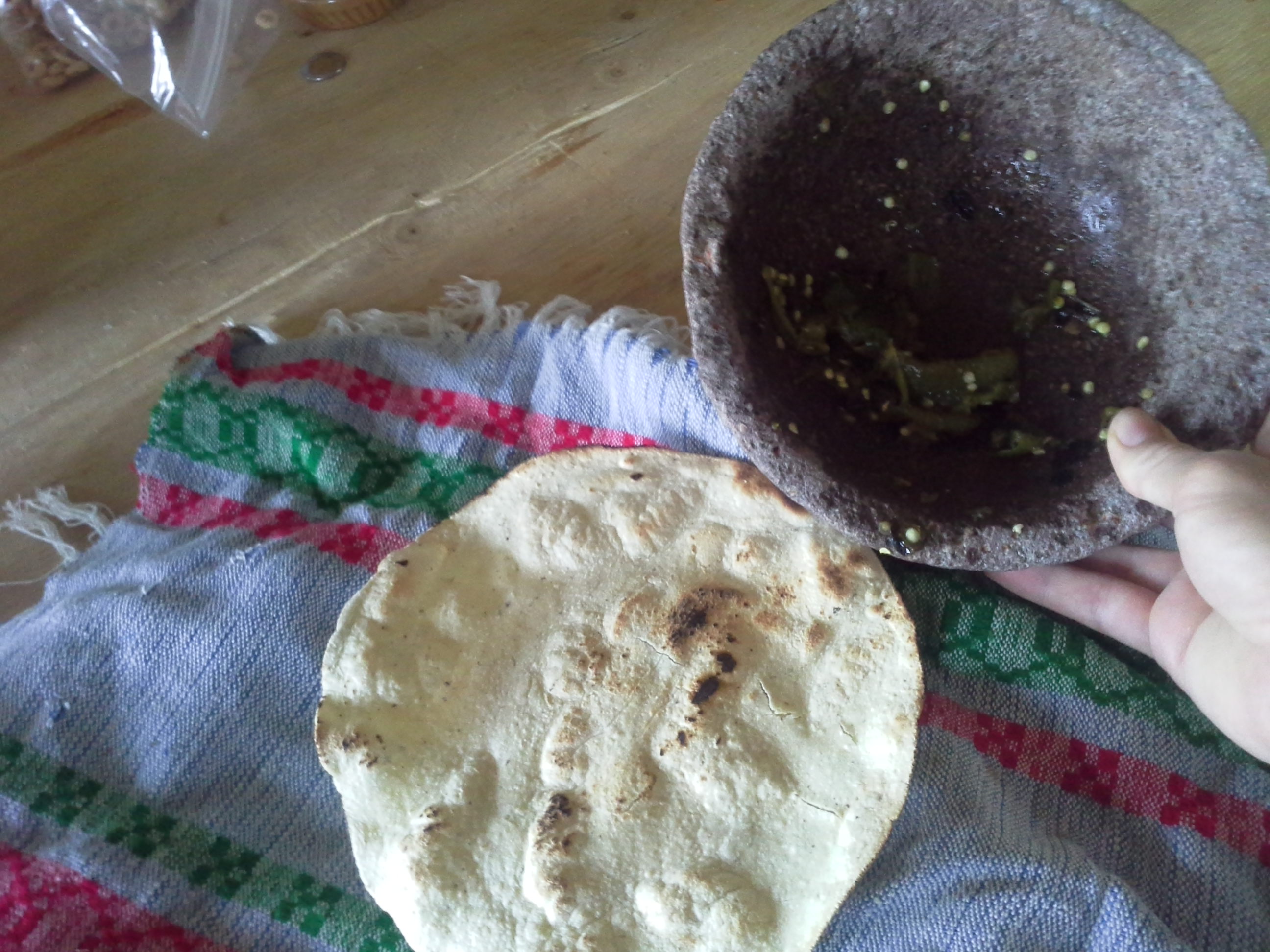
costeño salsa

Roast your chiles in a dry frying pan (or on a comal/griddle if you have one). Open all your windows before doing this because it will make you cough your lung out if you’re just standing there in front of the roasting chile. Move them around a bit so they toast on both sides. If it gets a little black that’s okay, you just don’t want to burn it down to ashes.
comalmy comal, still with chile seeds on it

2. Soak the chiles in water for a little bit so they get softer and easier to grind up in the blender. Put the garlic, some salt, and chiles in the blender with just a little bit of water. You want enough water to be able to blend it, but not much more or it won’t turn out. Blend until well pureed- ideally you want even the seeds blended in there well (which would take all day with my hand-cranked blender, but ye who have electricity have no excuse). Check the amount of salt and you’re finished.

chile costeño soaking

For chilaquiles:
Chilaquiles is a dish in the same vein as french toast; the idea is to re-purpose ingredients when they’re no longer at their peak but before they’ve gone bad. Instead of bread, you’re salvaging corn tortillas once you’ve already reheated them and they’re not soft and pliable anymore. So, yes, you can do like Mexican restaurants in Kentucky do and just use tortilla chips, but that defeats the purpose and it just doesn’t taste as good. When I lived in Kentucky, I would put my leftover tortillas (the extra ones I’d heated up for a meal but nobody got to) in a bag in the back of my fridge until I had 8-10 tortillas (good for 2-3 people, depending on size of tortilla and hunger level). You can also use a fresh package of tortillas- they don’t have to be stale tortillas, especially since it’s not like the ones you’re buying at the store there are super fresh to begin with. Here’s what else you need.

Ingredients:
-tortillas (for taco-sized tortillas, count on maybe 4-5 per person?)
-salsa (see above)
-oil for frying

(for serving, optional but highly recommended):
-chopped red onion
-chopped cilantro (optional)
-avocado
-queso fresco (or any cheese will do, but this is our preference- available at Mexican stores and many other grocery stores. However, some queso frescos are not so delicious- in that case it’s better to just get some jack cheese or some other mild equivalent.)
-sour cream (especially helpful for calming down the spiciness)
-eggs or other preferred protein accompaniment

(Yikes, I just made these for breakfast and already want them again. Writing is so hard!)

Directions:
1.    Fry tortillas in a decent amount of oil. This is not a breakfast for dieting. You will probably need to fry them one or two at a time so they brown well on both sides.
Heat the salsa in a large pan. You can add in a tiny bit more oil and a little bit more water, depending on the consistency of the salsa. Add in tortillas one at a time, flipping them in the salsa so that they’re well coated. You can break them into pieces as you put them in, or they usually break up pretty well on their own as you stir them around. Do not add in too many tortillas if you don’t have enough salsa- if your tortillas are dry the dish is no good. Better to either make more salsa or use fewer tortillas- better to add more accompaniments to the dish than have gross chilaquiles.
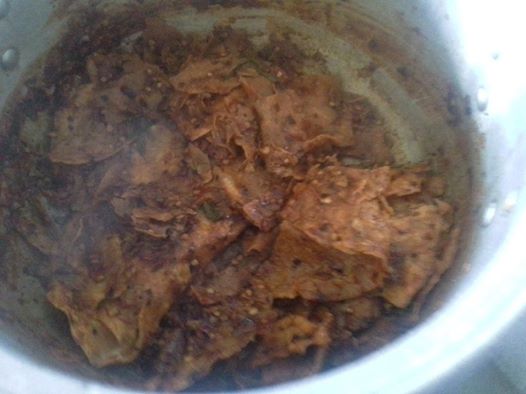
chilaquiles in the potfried tortillas mixed with the salsa

2.    Let the tortillas cook and soak up the salsa for a couple minutes (not too long or they’ll dry out) and you’re good to go. Fry up your eggs, get all the other bits and pieces on the table and you’re ready to eat. Don’t forget to invite Conan and me over!

A Little Bit of Nothing with a Touch of Everything (Perspectives on Having and Not)

20 Jul

“We don’t have a vehicle, we don’t have electricity, we don’t have anything,” (“no tenemos nada” because you get to double your negatives in Spanish) I announced, pouting like my two year old, and was immediately ashamed of myself. I was in my great big house (well, big for most Mexican families in Puerto) with my daughter and my husband and my gas stove that had plenty of gas, wearing clothes with more hanging on the rack, in my house with a kajillion toys for Lucia, and a bicycle, me with my full time job with benefits, in a safe and secure environment (except for those pesky neighborhood dogs, maybe) and, well, you get the idea. It could hardly be said that we’ve got nothing. 


Plus I was ashamed because I was saying it to one of Conan’s aunts who I happen to know had it a million times rougher when she was my age. She didn’t have electricity or running water. She took her four kids to the river every day to bathe and wash clothes and diapers. She cooked with firewood she brought home. Her husband drank all the extra money, and sometimes the money that was for food, too. And I’m pretty sure she still didn’t go around pouting about not having anything. 


But it was too late to unsay my words, and I was still too frustrated and flustered about the trash situation to fix my blunder. While it’s not true that we don’t have anything, we are living with a lack of goods and services that is sometimes overwhelming, especially because it’s so much more expensive to be poor in this way. 


What had me crazy for the moment was our having taken our trash out for a ride twice without being able to dump it. There’s no trash pickup on our block, so we’ve been accumulating trash in our garage for too long now. It’s difficult to convince somebody we know with a truck to come by and take our trash to the dump, but we’ve done it recently, twice in fact. To no avail. The first time the dump was closed because it was Sunday (although sometimes they’re open on Sundays). This time there was no reason for it to not get taken care of. Except I forgot where we are, and that it’s always possible for something to not be taken care of. So this time the dump was blocked due to protests- no, not the ever-striking teachers this time- some other group for some other political reason. All I know is that two or three months of trash (not food, thank goodness; we compost) returned to my garage, much to my dismay. I felt helpless, unable to accomplish what should be such a simple thing. But nothing is simple here, and even though I’m usually thrilled to be here anyway, sometimes it’s maddening.


People on our block mostly burn their trash, which is not only bad for the environment and our health, but only partially effective. You still end up with a big black pile of stuff that doesn’t disappear, like the aerosol cans of mosquito spray, a pile which attracts more mosquitos and is unsightly, among other things. Burning all that plastic and diapers and- ugh, the smell, and some nights it seems half of Puerto is aflame, big clouds of smoke billowing from all four directions. But what do we do? I’m sure we are attracting rats and all kinds of other pests with this ever-growing pile of trash, but where can we go with it, with no vehicle and some bad luck on our last two attempts?


And the trash is only one of our struggles for basic things that you probably take for granted, that I used to take for granted. Of course without electricity we don’t have lights at night, but that is not one of our biggest issues. We’ve got a couple battery-powered lamps and a couple more rechargeable lamps we recharge at friends’ or family’s houses when we can. The really big deals for me are 1) the refrigerator, and 2) the washing machine, or the lack thereof. 

With the fridge, we get around it more or less with a lot of extra work and a lot of extra money. We buy ice and put it in a broken fridge that we use as a cooler. Just to buy bags of ice is really expensive, plus it only lasts a day, if that. We can buy a huge bag that half fills our fridge for 30 pesos (less than 3 USD, but remember we don’t earn dollars) but because we have no car, going to get it involves getting a ride or borrowing somebody’s car, usually putting gas in it, etc. It is time-consuming, expensive, and totally inconvenient. We spend more on ice every month than an entire normal electric bill. 


The laundry situation is pretty similar. We can wash for free by hand here at the house, but it’s very labor-intensive and very time-consuming, with clothes and sheets and towels and all that for the three of us. We can take the clothes to a family member’s house and use their washing machine, but by the time we transport it there and transport the wet clothes back it’s about as much time and a little more money than washing by hand at home. We can take the clothes to a laundromat (where they wash them for you- that’s how it’s done around here) but it’s pretty expensive and there’s still the issue of getting the clothes there and back. And the worst part is we already own a wonderful washing machine in Juqulia, that would take a really large generator to run, which we don’t have. 


And then there are all these other annoyingly inconvenient things. Like the total inability to iron something I need to wear to work. Don’t get me wrong, I passionately hate ironing. But when it’s iron versus rewash and rehang something, give me the damn iron. Nope, not an option. 


The lack of fans is really killer when it’s crazy hot and humid and the wind decides to die completely. I love hot weather, especially because I can’t stand the cold, so I try very hard to not complain about it. But some moments I am convinced that all I want out of life is a fan in my face. 


And why don’t we have electricity? Let me be clear: we are not those folks who set out to build a log cabin and live away from all civilization, off the grid, sticking it to the man, or whatever. No, thank you. I want at-home internet! And ceiling fans (or any fans), and ice for my tea that I get straight from a freezer inside my very own house. And no, we don’t live out in the country by any stretch. We live in a large town, in a neighborhood right behind the big public university (which does have electricity, of course.) All around us there is electricity. Just not on our block. 


We don’t have electricity because we live in an alternate universe from the U.S., and the electric company just doesn’t work the same. Instead of going ahead and setting things up for electricity in areas that are developing, knowing they will profit from folks using the electricity sooner or later, they wait and wait and wait and make the now-desperate inhabitants of those areas pay for the set-up of electricity. So our block is in that process- getting quotes for how much they will charge us, rejecting them, trying to set up deals, asking for help from the government. It sure is a slow process. At the moment, there is no electricity date in sight for our house. 


Meanwhile, we have a survival plan, a plan to try to be a bit more like those folks sticking it to the man, a plan that doesn’t involve waiting around for the electric company. The fridge situation is half-taken care of (okay, still not convenient at all, but less expensive.) Paulina sent down her extra fridge which we’ve got running at one of Conan’s cousin’s houses (about a 15 minute walk away) so we can fill big water bottles with water to make ice for our “fridge”. We’re going to buy a large generator to run our washing machine and other odds and ends which are too much for solar energy. And we’re going to buy a solar panel which can hopefully help us run a fan and some other necessities that aren’t all the time. (It’s nearly impossible, unfortunately, to run a regular refrigerator on solar power). But all of these things take lots of money, and time to see where to buy them. If we want budget-priced solar panels we need to get them from Mexico City, for example. We don’t even know about the generator yet. I haven’t been at my job for long, so saving is also it’s own slow process. Like always, our life is a work-in-progress. 


I know it’s going to get better, to get simpler, and cheaper, and easier. And I know our life is far from all-bad at this point, even as things stand. I know I’ll never take basic services like trash pick-up and electricity for granted, ever again. I know I have a lot to be grateful for already. 


But I also think that it’s okay to feel whatever we feel, and that I need to give myself permission to feel overwhelmed, or desperate, or angry when that’s what I feel. I don’t think that has to negate all my other moments of happiness, of gratitude, of optimism. Maybe the way I expressed it the other day made me look like a tantrum-y brat, but I hope that Conan’s family knows me well enough by now to know that’s only a moment, that it’s not the whole Julia-package. And I think it’s important even to stay a little angry about the way the system is set up, the way the system screws over people that are already at a disadvantage. That doesn’t mean I have to walk around pissed off all the time; I think we can feel a full range of emotions in different moments and it doesn’t have to define us. Maybe what we tell ourselves about those emotions is more important than the feeling in itself. Maybe it’s okay for me to pout and complain from time to time, and it doesn’t have to mean I’m a spoiled brat. I can stop myself and recognize the wonderful things we have, once I’m finished pouting, that is. I can appreciate the best gift of all: allowing myself to be a complete, imperfect person, someone who can feel pessimistic and remain an optimist, who can cry and moan and smile and laugh in the same day, who can keep in mind the whole package deal, which might mean I have everything


A Dream, a Job, and a Legacy of Chispa

13 Jul

Sometimes things fall into place in such a way that you are assured that your life is a jigsaw puzzle and you’ve just found a perfect connector piece that’s enabled you to join a whole big block of pieces. I recently started a new job, teaching English in a university here, and it felt exactly like that.

headed to the office! another day in my perfect job...

headed to the office! another day in my perfect job…

Lucia on my work computer.... happiness....

Lucia on my work computer…. happiness….

I started at nearly the end of the semester, with students who had been teacher-less for three weeks to boot. The day I started, I still wasn’t even sure if I would be starting or not. Less than an hour before class time, I grinned and sat down with the other new teacher, hammering out a lesson plan. I dove in to the planning for the rest of the semester, leapt haphazardly and joyfully into the classes, completely self-assured and confident. And I have my Nonna to thank for it.

“Oh my goodness, I’ve given birth to my mother,” my mama frequently declared throughout my youth, often with a shake of her head or an eye roll, whenever I said or did things that mirrored her mother. My Italian grandmother epitomized my favorite word, chispa, which literally means spark, but also means something like pizzaz, gusto. She did a ton of amazing things in her life, travelling the world, habitually donating her time and money to others, being nice to strangers. She climbed the Great Wall of China in her 60s. She volunteered alongside Mother Theresa in Calcutta. When she came back, she convinced me to donate my allowance to sponsor a girl for school in India (along with convincing a bunch of adults to donate, too). She went on a pilgrimage in Spain with my Aunt Julia, walking and hitch-hiking along the Camino de Santiago de Compostela. On one of her many trips to Mexico, my mom remembers her picking up a woman and her children with their just-washed laundry and giving them a ride home. The woman then invited them to stay for lunch, which was exactly the kind of connections my Nonna made everywhere she went. She enjoyed helping other people and wouldn’t hesitate to ask for help when she needed it, too; she could convince any young person around that it was their civic duty to go find her purse or to shovel some dirt in her yard, for example. If her car broke down she didn’t worry because she’d convince whoever came by to push it or tow it or take a look under the hood, “why don’t you?”

She also put her own spark into the most mundane things in life. If she asked how you were doing and you said, “fine,” she demanded an explanation. If she was making a salad, she’d tell you an old saying about the four people required to make good salad dressing (a generous person for the olive oil, a miser for the vinegar, a wise person for the salt, and a madman to stir it all up). When you went on walks with her, she’d tell you names of trees and flowers you passed along the way. If you asked what a word meant, she’d tell you about the root of it, or what it was in Latin or French or that, actually, it comes from the German, and she’d give you some other examples to boot. My Nonna knew that reading is vital to life, that it can transport you all over the world, and that even seemingly useless facts learned from some magazine or some mystery novel can salvage your crossword puzzle or enrich a conversation when you least expect it.

She always did what she thought was best, and didn’t care what people thought about it. She used her arm to signal turns instead of the car’s turn signal. She would ask for “three fingers more” diet coke (or wine) to finish off her cigarette, and forget about the health problems of smoking because she insisted she didn’t inhale. She made you question everything, even her; If you told her some “fact,” she’d say, “where’d you learn that?” and wouldn’t accept it as fact unless you had a good source. (Of course she quoted her sources as well.) She lived by herself in a secluded area, and slept with a gun under her pillow. She gambled with pennies when she played cards, and she’d tell you she funded her first solo trip back to Italy that way.

My Nonna was also the best storyteller I’ve ever met. She would arch an eyebrow in just the right moment, belt out a laugh even during the tragedies, lower her voice to a whisper or suddenly shout at full blast whenever it was called for. The way her eyes would light up, the way she’d grab your arm in suspenseful moments, her expressive and constant gesticulations are ingrained in my memory, in my being. She taught me enough Italian in high school for me to get by in Italy (and if I’d actually studied I probably would’ve become fluent!), but I don’t remember my Italian anymore. What I do remember is the way she’d get distracted by a word or phrase and tell me a story- about her life, about my Italian ancestors, particularly about my foremothers. The Italian language is beautiful, but those moments listening to her, reliving and relishing our family history, were much more beautiful and lasting for me.

My Nonna spoke perfect Italian, English, and Spanish, although it didn’t come easily to her like it is for my Lucia. She was born in the U.S., but went back to Italy very young, and when she came back again to the U.S., she’d forgotten all her English. She repeatedly got kicked out of school over it, and her parents repeatedly returned her, insisting it was the school’s job to teach her English. Eventually she did relearn it, with more pizzaz and more perfect grammar than most native speakers on the planet.

I believe that she learned Spanish in college, and liked it so much she decided to teach it. She used to say that French is the language of lovers, Italian is the language of family, and Spanish is the language to talk to God. She was certainly a woman who felt she could commune with God, and I wonder if she really did feel more of a connection in Spanish. I wonder if she fell in love with it for all the other places it could take her, all the other people it could connect her to, the same way it happened for me in college. It is too late to ask her now.

Another amazing accomplishment of my Nonna’s was being a teacher who left an impression on her students. She taught Middle and High School Spanish for 25 years. Her students, the ones who didn’t dislike her for her high standards, appreciated her style, the way she talked to each person, no matter how young, as if they and their opinions truly mattered. They’d run into her in the grocery store and tell her, half-ashamed but smiling, that no, they didn’t remember any Spanish, but they really enjoyed her class, and where was she teaching now? Although she’d been retired for many years when she passed away, some old students of hers came to the funeral home, gifting us with stories of what a special teacher she was and how she affected their lives.

It’s too late to ask her now, but I imagine she had a teaching and living philosophy similar to mine, which is basically that life is fascinating. I think that her (and my) voraciousness for life come from a natural curiosity for everything, a desire to learn that is innate and insatiable like the oxygenated molecules pumping through my veins. I love to teach because I love to learn. I believe that everybody brings knowledge to the table, and that everyone can learn.

When I started my first job teaching English to adult immigrants and refugees, working in community centers in Louisville, Kentucky, I had no idea what I was doing. The experienced teacher who was helping me on my first day stood back and watched while I gesticulated wildly, repeated and rephrased and slowed and smiled and pointed some more, trying to get three women from Myanmar registered for the class. They had the least understanding of the registration process than anyone else in the class, but it was a challenge I jumped into heartily, believing in their right to education, and of course, wanting to do things well from the get-go. “You’ll be fine,” the old-hand teacher told me afterwards, nodding her head, maybe more to herself than to me. “Just keep that open attitude and you’ll learn,” she assured me. Granted, it took a lot of reading and studying and talking to other teachings and lots and lots of trial and error (a bit more than just a positive attitude) to learn how to teach English in that context. But I did, and I keep learning, and meanwhile my students and I have a damn good time doing it, because while it may not be the only thing in life, you can’t underestimate the importance of chispa.

But I digress, yet again. Really I wanted to tell you about a dream, about the real reason I walked into my new teaching job with zero self-doubt. A couple months after my Nonna died, when I was happily teaching English in Louisville, I dreamt that I suddenly landed a job teaching English in a university in another country. But it was the first day of class and I realized I hadn’t made a syllabus. The perfectionist in me revolted, declaring total failure. I turned red in the face in class and tried to assure the students I’d have their syllabus the next day. I made it through class, only to get home and realize I had no idea how to write a good syllabus. It was just too much for me and I wasn’t cut out for the job, obviously. My panic destroyed all my efforts and I went to bed defeated. Meanwhile, my Nonna came along, in that special way of dreams, where I didn’t see her or hear her precisely, but felt her, clearly and strongly. She said something like, “Don’t worry, kiddo. You’re not the first to do it. I’ve done this before you, and it’s not as hard as you think. You’re gonna be just fine,” (and she might’ve nudged me gently in the ribs, or maybe I added that later). She left me a syllabus on her kitchen table, a fabulous outline that I just had to adapt slightly for my purposes.

The sensation of her presence and the strength of her confidence in me have stuck with me since that dream. Although perhaps it was something sown and watered and tended in me long before that. My mama might be exaggerating about giving birth to her mother (and I’m pretty sure I’m not that awesome- yet), but I have no doubts about the strength of our bond, which even death can’t destroy. I am so sure of it that when I started this job, thrown into it with no time to plan, with no experience in a university, I laughed and jumped in, sure of my place, knowing my Nonna and my chispa would carry me through.

Where The Wild Kids Are

6 Jul

I was completely taken aback the first time I saw a small child get sent on an errand by himself by a perfectly reasonable, respectable adult. When I was visiting Mexico a few years back, I had seen a five year old get sent for beer- which yes, was sold to him. I was able to rationalize that, since it was an incredibly small town, and I could hardly say anything, since I was the beneficiary of the procured beer, being a guest at the house. Although I admit I might have had some judgmental little thoughts about the situation.


This time, though, as a brand new resident of the fairly small town of Juquila, Oaxaca, Mexico, I tried to insist that I would go to the store instead of the four year old in question. “You don’t even know where it is,” Paulina sensibly reminded me. “And Emma’s really fast. He’s a very smart and helpful four year old,” she said, in that special way that moms say things, talking to someone else but making sure the child can hear what you’re saying, praising them so that they continue to do whatever positive thing it is that you want them to do. (I bet some parent or the other invented psychology way before that jerk Freud. Necessity is the mother of invention, and mothers have lots of necessities, right?)


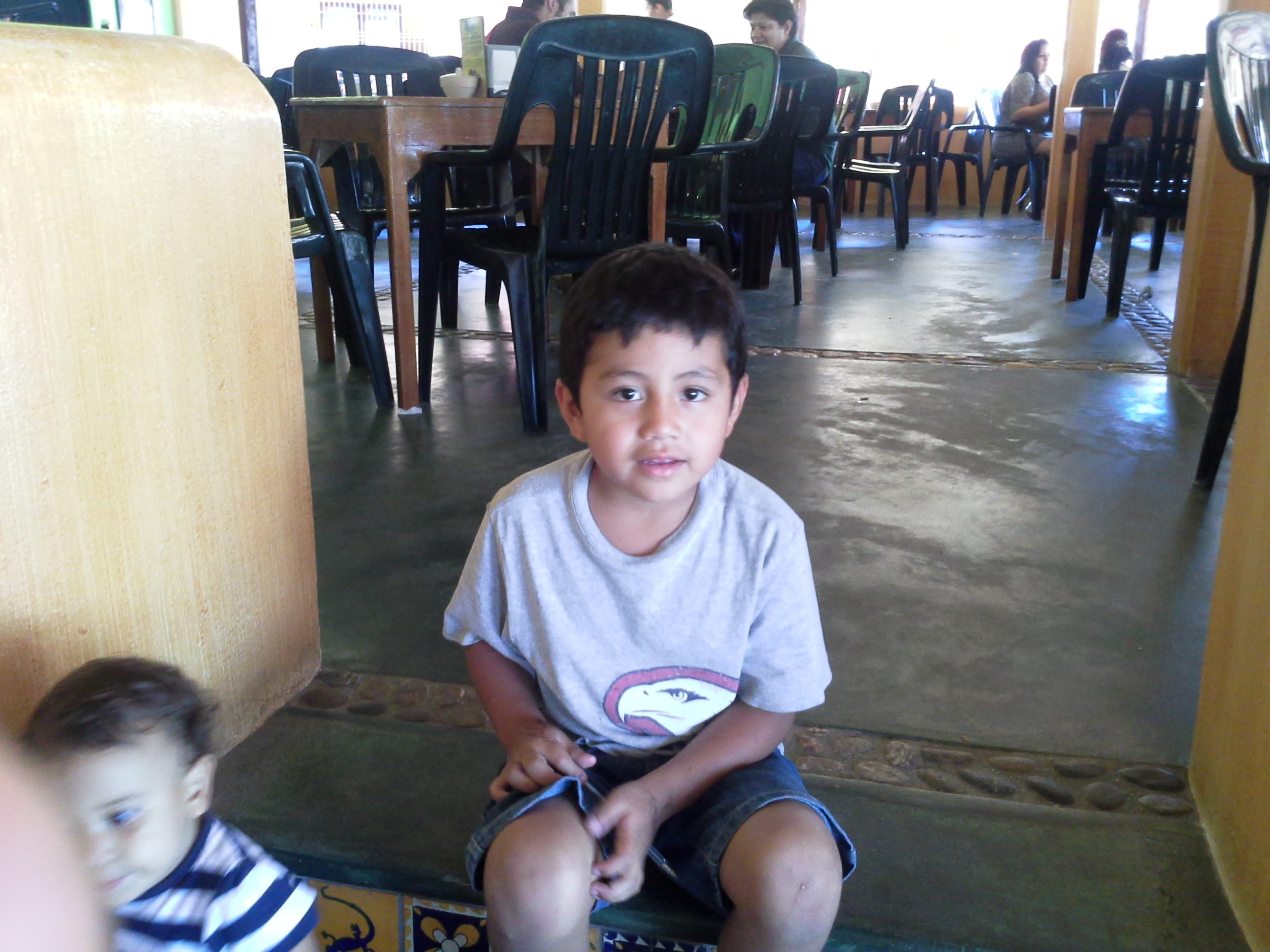
Emmanuel, now almost 7 years old

Emmanuel, now almost 7 years old

Wild children of Oaxaca: Lucia and her cousins having unstructured playtime!  Yes, they are riding a horse (broom) together

Wild children of Oaxaca: Lucia and her cousins having unstructured playtime! Yes, they are riding a horse (broom) together

“But are you sure he should go by himself?” I asked skeptically. When I was a kid, back in the late 80s and early 90s, I wasn’t allowed to go to Walgreens, just a couple blocks away, by myself, until I was probably seven or eight. By then I had been well trained in the ways of dealing with strangers, tactics in avoiding a kidnapping, including a “safe word” that would be used if anyone ever had a legitimate reason to pick me up because my parents couldn’t. I grew up with clear and small boundaries; we didn’t cross the alley without permission, we didn’t even go inside another kid’s house without letting our parents know where we were. Over time, of course, my boundaries expanded, but always with a bit of hesitation. The reminders were everywhere- kids’ faces on milk cartons, news report and stories of missing children, abused children, molested children. These things make parents cautious, with good reason. Nevermind that most child abuse happens via family and close friends. Nevermind that we all got flashed by that poor homeless guy that talked and yelled to himself, without us having crossed the alley. We still grew up learning that the world of strangers is a dangerous one, and that going anywhere without parents is a grave responsibility, not to be taken lightly.


But little Emma (short for Emmanuel), about to turn five at the time, was full of confidence and determination. “Tsí, yo voy!” (Yes, I’ll go!) he said, still not able to pronounce his s just right. “Give me the money,” and he held out his little hand. Paulina made him repeat back the order- Lala semi leche, the the Lala brand blue carton of milk. “If it’s more than one thing I write it down and he hands the paper to the clerk,” she told me. “But it’s fine; it’s just right down the street. I never send him on far-away errands by himself,” she assured me.


“What about cars? Does he have to cross the street?” I asked, still concerned.


“Ah, Emma knows how to watch for cars,” she said. “I’ll tell you some more about Emma in just a minute. Don’t you worry.”


Emma is one of Paulina’s neighbor’s kids. The neighbor is a single mom with 3 kids under age 7 and, at the time, another on the way (who’s just a couple months behind Lucia). She has very little help and almost no family support, other than her mother begrudgingly giving her a room, which she pays off by helping work in her mom’s hotel down the street. There are no food stamps in Oaxaca. There is very, very little financial help of any kind for single moms, or really for much of anyone. So somewhat understandably, Emma had not been the most well-cared-for child on the planet. He had had to learn all kinds of important lessons on his own, through trial and error.

In addition to being what Paulina calls a survivor, he is a sweet as pie and thoughtful as all get-out when he’s not being jealous or grumpy. He had started to go next door and “bother” Paulina and Arturo regularly, from the time that he could walk- hanging out with them, sitting on Arturo’s lap. Over time he spent more and more time there, until Arturo and Paulina started to call him their child- half-jokingly, but only half. His mom still has the major responsibilities for things like getting him to school, making sure he gets his lunch, things like that. But he eats as often at Paulina’s table as he does at his mom’s (chow-hound that he is, sometimes eating a meal in both places!). He often goes out of town with Paulina and Arturo; we met him when he came to the Oaxaca airport with Paulina to pick us up. It’s a unique and lovely relationship that they have, and I think it’s beneficial for everyone concerned in distinct ways.


So Emma and his over-sized baseball cap came back from the store with the carton of milk and the change. What I didn’t realize at the time was that Emma’s independence wasn’t an anomaly, nor was it an exception caused by his mother’s difficult situation. I thought at first that Paulina was emphasizing the fact that Emma had had a difficult start to life and that’s why he could cross the street by himself, when really what she was telling me was what an exceptionally smart and helpful kid Emma is despite his difficult life. What she really was telling me was that Emma took pride in washing his own clothes at Paulina’s house, while his one-year-older brother did no such thing to help his mom. What she really wanted to stress was that Emma had learned how to cross the street from a very early age, that he always volunteered to go on errands, that he is a fabulous kid, in part, of course, thanks to her influence. She wasn’t telling me, like I interpreted initially, that she could give him more responsibility because nobody had bothered with Emma’s welfare for periods of his short life. She was telling me she could give him more responsibility because he’s a great kid.


Lots and lots of kids around here get sent to the store by themselves, practically from the time they can toddle, on. Lots of kids get to go outside and play without telling their parents exactly where they’re going and how soon they’ll be back. Kids wander farther than I was allowed to with twice their age. Kids get sent on errands. Kids get sent out to sell the milk from their family’s cow, to sell the tamales their mom just made, to go get change for the family storefront from some other business down the street. The twelve year old whose parents run the plastic store in front of Paulina’s house would sometimes be left alone to take care of the business, plus his four year old brother. A friend of ours would leave her ten year old alone asleep in the house and go out for a while, making sure the door was locked for protection, of course. This is all normal here.


I was shocked and, yes, maybe a little appalled by this when I first arrived. But the thing is, it is not some desperation that makes parents give this kind of independence to their children. It is not a laziness in parenting, as the average U.S. citizen might assume. Of course, there are kids who are victims of necessity, who are out selling stuff at all hours of the day and night, whose education suffers or is nonexistent, who live in extreme poverty despite everyone in their family’s best efforts, or sometimes because of a parent’s alcoholism, or a parent’s lack of other options. But for the most part, the kids you see out running errands, the kids helping run the family business, are just learning to be productive members of society as their parents and their culture see fit. They are learning independence in a world where, unfortunately, there are kidnappings and other horrendous crimes against children, but that isn’t the driving influence in how people treat their children. The fear of those things doesn’t make parents restrict their kids more and more.


Of course there are some parents more protective and worried than others. One of Conan’s family members won’t let her 15 year old take public transportation to school, not because she doesn’t trust her daughter (she says), but because it’s too dangerous a world out there. No matter what culture you live in, there has to be some kind of balance between trying to protect your children and teaching them to be relatively self-sufficient, contributing members of society.


I think for the most part, Mexican parents do really well at this. I think that kids like Emma who learn how to wash their own clothes (by hand, no less), run errands, make change, and a plethora of other useful life skills from a very early age have better “self-esteem” than kids who are praised for every squiggle they draw on a piece of paper, whose parents see every soccer move they make, who are micro-managed and not given “free time” ever.

Should there be a balance? Of course. As parents, we all struggle with this. You know your kid needs you to “ooh and awe” over their beautiful squiggles sometimes. They need someone to remind them that their effort in the game was great, even though they lost. They need some supervision. They need some rules and structure. They need attention and for you to play with them sometimes. But there are practical limitations to that as well as philosophical ones. You can’t play with your kid all the time because you have to cook dinner, you have to do the laundry, you have to go to work, etc. etc. You need some “you” time occasionally, too. And I think we would create ridiculously dependent, helpless children if we were only focused on their needs all the time. We have to think of the needs of the whole family, including our personal needs.


Furthermore, children need and deserve to have their own role in the family, to be contributing members of the family, with some age-appropriate level of self-sufficiency and independence. One of my life’s heroes, Dr. Maria Montessori*, talks a lot about this kind of thing in her philosophy of education. Whether it’s just pouring their ownmilk in the morning, or setting the table for the family, or selling some of their mom’s tamales, children are growing, blossoming humans who need to feel useful just like you and me. And so while I won’t be letting Lucia stay home alone at night (even for a little while) anytime soon, I will, someday, be sending little Lucia off to the corner store, a note and the money in a bag. I can already see the huge smile on her face when she’ll come back, another mission completed by my developing, proud, independent little human.


*She was the first woman in Italy to become a doctor, but she got interested in education by working with children who were thought to have problems learning, and she ended up dedicating her life to education. Her ideas about education are revolutionary, beautiful, and practical. You can read more about it at this site or a host of others: http://amshq.org/Montessori-Education/Introduction-to-Montessori

-On another note, you can probably see, after reading this post, how easy it is for perfectly good parents (from other countries who are living in the U.S.) to get Child Protective Services called on them. Another important role of adult ESL teachers, journalists who write in other languages for immigrants, and other ambassadors in the immigrant community- education about these important cultural differences!

The Whole-Family Honeymoon

29 Jun

It wasn’t supposed to be a honeymoon exactly, but I wasn’t exactly thrilled, either, when Conan invited his mom to go with us to the beach a couple months after we first moved to Juquila. She was sitting there with us when we started talking about going, and it didn’t occur to Conan to consult with me before suggesting she go with us. Not that I don’t enjoy her company; in fact, she and I get along fabulously, much better than she and Conan get along. And it wasn’t that I didn’t want her to go, particularly. And after pondering over it I realized it would’ve been extremely rude to not invite her. But I admit, if Conan hadn’t invited her I wouldn’t have; I don’t think it would’ve even occurred to me! Perhaps I was thinking that living together was already enough quality time and that Conan and Lucia and I needed some time to be alone as a little nuclear family. I am, after all, a product of that oh-so-individualist, privacy-obsessed, nuclear-family-making country called USA, where the only unity is in the name United States.

Sometimes Mexico feels like an alternate universe. There is no emphasis on individuals and individualism. Like in most other countries, many people live with their parents and often other extended family, usually until they are well beyond being “young adults”, and often until their parents pass away. It’s not about not growing up or just depending on your parents the way we would think of it in the U.S., but rather about an inter-dependency that goes on in families- because there’s a lot to do, because life is expensive, and because those are still the cultural values of most families around here.

Conan and I had agreed to live with his mom for at least a year, which was only fair since he hadn’t seen her in 10 years. And it was a huge help to us- having a place to live, totally furnished, totally free, with someone to help us out with all the things we didn’t understand or know, like where to get the cheap cleaning products, where the best tlayudas are, when to go get Conan’s ID.

Additionally, it was a fine and dandy situation because I really like his mom and we all help each other very well. I am eternally grateful that when Lucia was a baby I lived with someone (besides my partner) who loves and helped take care of my baby every day of the week. I could go exercise and shower without worrying about Lucia- big pot of gold luxuries that most moms in the U.S. don’t have. There was an extra person to share cooking and chores with, which was pretty fabulous as well. Conan and I, in turn, helped her with various other things around the house and in her store, in addition to just keeping each other company.

Mostly, it was a win-win situation. Occasionally, though, I wanted some “gringo” time- some time away from the family. I wanted to “get away from it all” on the beach. We had gone to the beach a week after we moved to Mexico, but it was a trip with my mom, and his mom, and his stepdad, and, well, it wasn’t exactly romantic.

My Dad and Karen (my stepmom) on another family vacation!

My Dad and Karen (my stepmom) talking with Paulina and Arturo (not pictured) on another family vacation!

My in-laws on another family vacation!

My in-laws on another family vacation!

Granted, with a four month old baby, nothing is very romantic for very long. But even beyond my longing for romance, there’s my longing for privacy. I got worried when Paulina mentioned those hotel rooms we had looked at with my mom, where you could put up to 3 people in a room for 250 pesos. I knew her idea was to be her extra-frugal self, not to invade my sense of privacy. But nonetheless I started plotting and planning for nice and polite ways to escape sharing a room with her. But how do you tell your well-meaning family to please go away? It is no easy task.

I still hadn’t figured it out by the time we got to Puerto. But I had enlisted Conan’s help and we were going to play it by ear (the only way to play anything down here, ever; even after a couple of months I was starting to learn that planning was a futile effort). Upon arriving in Puerto we went to visit Conan’s aunt Artemia who lives here. One of his cousins, Benja, his cousin’s wife, Luz, and their two kids also live there. Since Conan hadn’t seen them in 10 years, it was a big reunion, and also his first time meeting the wife and kids (and their first time meeting me and Lucia). They are lovely and wonderful people and I had a great time hanging out with them, that first time and a kajillion times since then.

But the gringo in me came out when they offered us a place to stay. I should have felt grateful for their generosity, which I’m sure would also include sacrifice of their own comfort (sharing beds to make room for us, sacrificing their privacy, etc.). But instead, I’m ashamed to say my immediate thought was “Shit! How can I communicate to Conan that I don’t want to stay here?! How can we get out of this politely?!”

See, I had this image of the 3 of us- me, Conan, and Lucia- in a little room or maybe a small cabin right by the beach. We’d wake up and walk on the beach. We’d lounge around together, enjoying the respite from washing diapers and cooking and cleaning, etc. We’d have dinner at some beachside restaurant, slowly, leisurely, enjoying our little nuclear family. We might even get to spend some adult time together after Lucia fell asleep.

None of that was going to happen if we stayed at his aunt’s house. But the offer was on the table, his mom and his aunt and everyone else all looking at us, awaiting our answer. Conan read my mumbled “I don’t know, what do you think?” correctly. “It’s just that we had talked about staying in a hotel room together.” He explained. “I’ve always wanted to stay in one of those places on the beach. Gotta take advantage while we have the money. It’s kind of like our honeymoon.” He added. Granted we were not married at this point, so I’m not sure where the honeymoon part came in, but it worked.

And everything else fell into place, like these things usually do. Paulina accepted the invitation to stay the night at their house, so she wasn’t bunking with us. And while it might’ve made us seem just a little snobby, rejecting their hospitality to stay in a hotel, at least we bowed out somewhat gracefully.

At the time, it wasn’t that I turned my nose up at their hospitality, but I was not thrilled at the prospects, either, of spending the night with the outside toilet you had to pour water down to “flush,” or the shower that was just a half-concrete, half-tin tiny rectangle at the entrance to their property, where you filled up the bucket to pour water over yourself. I was concerned, of course, about the ratio of beds-to-people and the amount of air that could circulate with a little floor fan in each of the two little rooms. I was worried about the mosquitos that had already started devouring my baby, and the lack of screens on the windows. Although it didn’t seem like a bad place by any means, and I had stayed in much less-luxurious circumstances before, it felt like “roughing it” too much with Lucia in tow, although her one-year-older cousin lived there. Plus, I really, really wanted a night or two of privacy, an after-baby, post-moving “honeymoon,” as Conan had put it.

So we got our hotel room “honeymoon,” which was neither the private nuclear-family-centered time I had envisioned nor the all-family-all-the-time affair that it would’ve been if we’d stayed at his aunts house, or shared a hotel room with Paulina.

We rejected his aunt’s hospitality that first visit, nicely and graciously, we hoped, without knowing that a year later we’d be living in a tent on their patio for weeks while we worked on our house. I didn’t realize then how much we would continue to depend on family and how they’d come to be the center of our social circle as well. I didn’t realize that depending on people doesn’t make you a dependent or needy person, but rather it helps you keep life in perspective and become a more dependable person yourself. It means you can’t say no when a cousin’s kid needs help with some homework because they’ve been recharging your lamps for months. It means you are racing to do the dishes when you’re invited over because they never let you do the dishes when they come to your house. It taught me to accept help without feeling like a failure, without looking for ways to pay it back, just knowing that the time and place will arise.

But at first, my appreciation was sometimes more theoretical than practical. Sometimes I felt grateful for what I had while simultaneously pining for a different situation. At the time, for example, I recognized how lucky I was to have my mother-in-law’s unconditional hospitality, good conversation and company, and her constant contribution to our child-rearing and childcare. But my independence-obsessed roots didn’t die, and sometimes I thought I’d lose my mind if I didn’t get my own space, if I couldn’t have a few days of throwing off my clothes and leaving them where they fell, of ignoring the dishes without worrying that I’d be judged lazy. Sometimes I went to our bedroom and fumed and stewed and cried and wrote my little heart out about the frustration of other people telling me what was best for my baby. I found a note in my journal the other day, something I wrote Conan and never gave him, about refusing to be kicked out of the kitchen, because I’d been told it was too cold for Lucia up there with the wind coming through. I remembered my bitterness, how some days our promised year in Juquila couldn’t go by fast enough, even though we had no definite plans for the future, nowhere to go afterwards.

But while you U.S. readers might be appalled at that kind of “meddling,” folks down here are shocked and appalled by what they see as the callousness and uncaring of families in the U.S., the lack of meddling that they see as indifference. For example, when a woman has a baby here, most of the time, someone or several people take care of the mother for 40 days after she gives birth, making sure she doesn’t have to do any washing or any other strenuous activity, making sure she gets enough rest and can focus on her baby and her recovery. Imagine what that kind of help is like! But of course there’s a trade-off. Life’s full of trade-offs, and I think we all just have to find the balance in whatever situations we have to work with. And yes, when we actually did get married we had some of that balance- a night in a hotel room that my awesome gringo side of the family sponsored us for, and the big after party the next afternoon, where everyone came to our house. While I was reeling from exhaustion and a bit taken aback at having guests the day after the wedding, it all worked out beautifully, with all the food prepped for us and almost all the cleanup taken care of for us by Conan’s family. And so continues the adventure in multi-cultural family building, a relationship in progress for the whole family on both sides.

Getting Back In Shape, One Snarky Comment at a Time

22 Jun

Although soap operas were prohibited from my childhood, it didn’t stop me from developing my own dramatic flair. I’ve spent years crafting what I hope are fabulously scathing responses to rudeness, whether it be yelling back at catcalls while I’m on my bike, smiling politely while I tell a business exactly why I’ll be conducting a smear campaign against them, or writing a perfectly understated resignation letter ‘appreciating the opportunity’, even though I’ve made it clear through other means that I’m finished dealing with the boss’s raging alcoholism. I’ve been refining my sarcasm since toddlerhood, dreaming up blithe and amusing come-backs in my spare time (admittedly I’m no comedian, but I amuse myself at least). Tragically, all my effort is for naught when the cultural definitions of rudeness change and I have to think up new snarky responses to damn near everything.
For example, if someone in the U.S. insisted I tell them how much money I make, I might ask if they need to see my bank statements, or if they’re trying to figure out if I’m good marriage material. But it’s never happened to me there before so I was thrown for a loop when my friend here asked about my new salary. I simply said, “It’s a good salary,” leaving the peso value to the imagination. “No, but really, how much?” she asked. And again I told her something vague. I even used Conan’s favorite line from when he was in the U.S., telling her that “In my country,” (theoretically putting up a barrier I could blame on our cultural differences,) “we never say how much money we make.” She didn’t get the blatant hint, though, and said, “But I want to know!” Finally a family member told her to let it go, although I think they wanted to know, too. I imagined that this was just my friend’s personality, since she is one of those brutally honest, say-the-first-thing-that-pops-into-your-head types. But then several other people asked me the same thing, also not accepting my non-exact descriptions. Chalk it up to yet another instance of my basic social norms being ground up and remade into something barely recognizable.

And then there are the people who want to know when the baby is due. Granted, I was carrying around an extra 10 pounds for longer than I wanted after Lucia was born. And yes, it seems that anymore every half a pound I gain goes straight to my belly. But when I was actually pregnant in the U.S., people not-in-the-know didn’t ask me about pregnancy until my belly was practically basketball-sized. Here, on the other hand, I can even be out drinking a beer and still have someone ask me if it’s a boy or a girl. And I’m only 5 pounds heavier than normal right now! Hardly big enough to know the sex of a nonexistent baby.

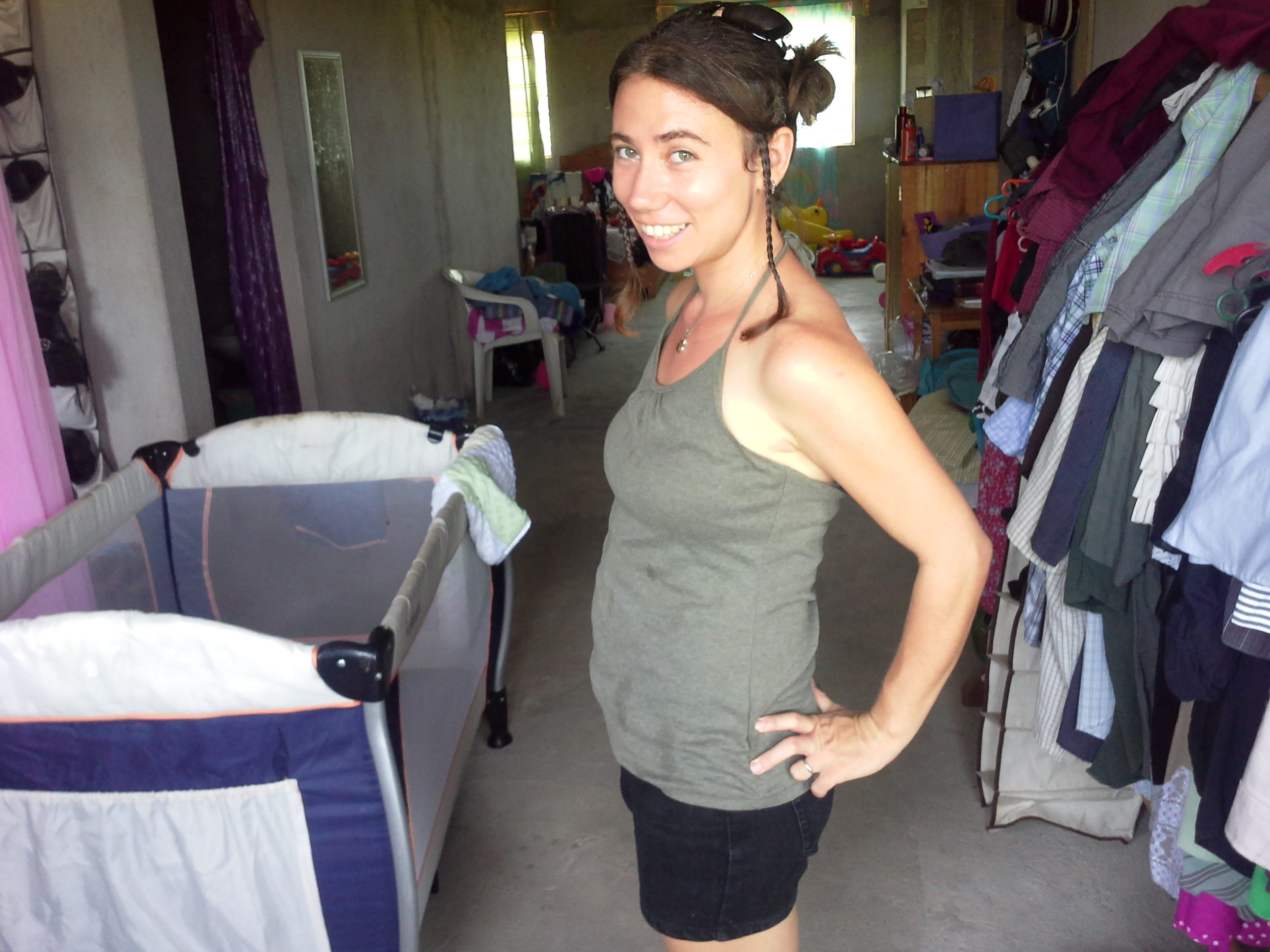
Belly Bulge: A growing fetus or an excess of tortillas? Just ask! Or just keep your mouth shut.

Belly Bulge: A growing fetus or an excess of tortillas? Just ask! Or just keep your mouth shut.

Also, there is a version of customer service in some places here, but it only vaguely resembles the super kiss-ass, customer-is-always-right policy we have in the U.S. Restaurants, for example, resemble Europe more in that if they bring you food and drink sometime today and aren’t outright rude and ignoring you, that’s great service. It’s true that servers don’t live off of tips here, either, but that’s not the only place where our idea of service is seriously lacking.

There are three banks and a credit union here in Puerto, but you’d never know that by the service; there is certainly no competition in treating customers better to win them over from another bank. You are liable to wait in line for an hour or more (I’ve waited for more than 2 hours before on a day before a holiday) and nobody even apologizes. In fact, you’re lucky they got to you at all and you might as well be grateful that the bank exists.

I’ve heard that one of the banks is the most together, organized, and quickest in town, but it still took me three trips to finally be able to open my account there. Like in the U.S., the basic teller services are separate from the more complicated services, but still I waited over an hour and there were still people in line ahead of me, although I counted three cubicles and only four people ahead of me when I had walked in the door. The second time I went in I nearly threw a tantrum when some lady cut in line ahead of me, going straight back to one of the cubicles. The banker blew me off. I got seen in less than an hour that time but they couldn’t open my account with my water bill as proof of address; they needed an electric bill. I explained that we don’t have electricity, and the banker kindly assured me that, “oh, no, it doesn’t matter; just borrow any friend or relative’s electric bill.” So much for legitimate proof of address.

On my third visit to the bank, I was finally able to open my account, but only because I complained that it was my third visit in a week and my lunch break was going to be over soon. I magically got pushed ahead in the line, and didn’t even care that it was unfair. Once I was in a cubicle it still took an hour for the banker to fill out all the paperwork, for me to put my signature on a million sheets of paper. The copy of my immigration card didn’t look good enough as a copy, so he had to take a picture with his phone and email it to himself. Then there was a W-9 from the U.S. I had to fill out, supposedly to make sure my U.S. Social Security number is correct (why is this important to the U.S? or to Mexico? Who knows?), which the banker had no idea how to fill out. I was too relieved about getting it done to care.

A couple days later the same banker called me, informing me (not asking me) that I had to return the next day to correct a mistake. He said I’d abbreviated my name on one of the forms and that it had to be turned in correctly by the next day. I was starting to feel like I had a second home at the stupid bank, but at least he promised I could go right back to his cubicle and not have to wait in line. (Maybe something similar had happened with the woman I had complained about!)

Sure enough, I had “abbreviated” my name on the W-9, putting my middle initial instead of my whole middle name. I should have remembered about this cultural faux-paux because the first time I sent money to Conan I made this mistake and had to resend the transfer. Even though there are probably no other Conans in the entire country of Mexico, and even though he had the correct code number for the money transfer, they just couldn’t be convinced that “Conan Palacios Lopez” (the name I’d put on the transfer) was the same person as “Conan Rene Palacios Lopez” (the name on his ID). (Oh, my dear adopted land of arbitrary enforcement of banal rules, I love you even though you make no sense.)

And on and on it goes. Eventually I’ll quit being surprised by these things and will get it together to come up with new amusing and appropriately scathing responses to all this absurdity. Thus far I’ve been too busy refining my ability to laugh at myself and at the circumstances instead of inventing good come-backs. I just hope I can keep my brilliant sarcasm in shape and exercise my witty expositions of irony, at least in the retelling of my surprise and dismay. So bring it on, Oaxaca; I’m here for the long haul and there’s no TV to distract me from redeveloping my own dramatic flair.

never-ending amounts of fresh tortillas (and homemade salsa): not good for my waistline

never-ending amounts of fresh tortillas (and homemade salsa): not good for my waistline

I’m Still Cool- Whether I Have Purple or Gray Streaks in my Hair!

14 Jun

It was heartbreaking and shocking for me the first time a teenager treated me like a grown-up, like I was the enemy authority figure and couldn’t possibly understand them. I was working in a fabulous after-school program with my amazing mentor/ second mom, teaching about holistic sexuality, among other things. I kind of expected the kids to automatically think I was cool based on the content of the program, as I would have at that age. And I was only 18 at the time, still a teenager myself! Didn’t they get the memo that I’m anti-authoritarian? Didn’t my rebellious, alternative hairstyle (often with colors like purple) clue them in that I was (and am) young and vibrant and cool?!

I’m 30 now, but I still can’t really believe it when kids want to rebel against me. Luckily my daughter’s only two so I have a few more years to practice getting used to this. It was still a bit shocking to get the news a few weeks ago that I appear to be an authority figure to college students now. I mean, it wasn’t that long ago that I finished college! And I still have cool, weird hair! Why don’t these kids get it?!

I have to hand it to them, though, their delivery of the news that I’m someone to rebel against was pretty amusing. I was substitute teaching a university-level English class and things seemed to be going well. They were working in small groups, using the imperative to write rules for a movie theater (which, by the way, doesn’t exist in Puerto. The closest one is 2 hours away.). I was walking around checking on groups, making sure they were on track and didn’t have any questions. I got to this one group, whom I suppose are some of the “cool kids,” all boys except for one girl. Their use of the imperative was on the mark, and they mostly had good rules. Except, “I think you need to change this one right here,” I said, and pointed clearly to the obvious culprit, the one that said “Don’t fuck!”

Now, don’t get me wrong; I myself am a user of the F word. I am my father’s daughter, and my dad is an expert at the F word, the S word, and the every-other-letter-of-the-alphabet word. He taught us that the creative and colorful use of “bad words” is an important skill in life. The F word, in particular, is so fabulously versatile, converting itself effortlessly from verb to adverb to noun to adjective and beyond. It is a curse word that an English teacher can appreciate.

But there’s a time and a place for everything. On top of that, their regular teacher had emphasized that there were strict class rules about being respectful, including not cursing in class, and that she throws students out of class for breaking the rules. So the situation had to be dealt with.
I wasn’t sure if they were trying to impress, or shock, or rebel, or if they just wanted to see what I would do.

Needless to say, I was not impressed. I was definitely not shocked or uncomfortable. “Shit,” I realized later, “I’ve been using this word for the same amount of time these kids have been alive.” Perhaps I am aging! But I am aging with pizzaz and style, if not grace, and really I was amused more than anything. Unfortunately, I had to be the one to enforce the idea that there’s still a time and a place for everything. So there I was, waiting for their reaction to my calling them out.

“Which one?” asked their little leader, casually, as if the problem might just as easily have been the one that said, “Be quiet.”

So I pointed again, smiling slightly. “This one,” I told him, not taking the bait.

“But it’s a good rule- don’t fuck,” he argued, all mock innocence, so pleased with himself for saying it out loud in front of all his friends and the substitute teacher.

I used my mom skills to keep a neutral face. “It is something people shouldn’t do in a movie theater,” I agreed, in English, “but I don’t think it’s something you will find written in the movie theater. Not in those exact words, anyway. It’s not appropriate. You’ll have to think of something better.” And I smiled again encouragingly for good measure.

After class, I approached their group and told them, in rapid-fire Spanish, “Look, it’s great that you know bad words in English! Congratulations. That’s an important thing to know, but its important to know when and where to use them. This class is not where you use them. You all already know that. You know that it’s disrespectful to your classmates and that your teacher would throw you out of class. So don’t do it again. This is your warning. Got it?” My tone of voice was that great mix that only parents and teachers can do, a mix of “I’m all business so you better pay attention” and that sympathetic “it hurts me more than it hurts you.” I started off smiling, then bored holes into them with my eyes as I spoke, then smiled again at the end, especially when they nodded, half open-mouthed, that yes, they got it.

I walked away feeling I had triumphed, getting my message across, although I also felt a little like a traitor, having to establish authority like that. Contrary to what younger people think, it’s not always easy or pleasant to be the one “in charge.” Surely there are folks who get a thrill out of bossing people around, keeping folks in line and the like, but I am not one of them. I’m more of a let’s-establish-ground-rules-based-on-mutual-respect sort of teacher. Thanks to teaching English in other contexts, where often students were older than I, I’ve had the luxury of not being that kind of authority figure, the one who has to, like, invent and enforce consequences for breaking the rules. This is also why I’m an ineffectual mess in large groups of small children. I expect people to just follow the rules because there should be rules that make sense, and if the rules don’t make sense then we can just change them.

Alas, I guess it doesn’t always work like that. I guess I can be forced to act like an authority figure, although I hope I do it the same way I am aging, with pizzaz and style and really cool hair, gray ones and all.

Rabid Dogs and Hypochondria and All

8 Jun

Now that I am pretty confident that I don’t have rabies, I think I’m ready to discuss the dog situation around here. If I turns out I do have rabies someday, then scratch this whole piece and go ahead and shoot me. Meanwhile, read on:


Like many countries without a giant budget for animal control, there are a lot of stray dogs. In fact, apparently only about 30% of dogs in Mexico have homes.* And since no country throws out food like the U.S., stray dogs are not fat little scoundrels roaming the streets. So even though we made fun of her a little, we all also understood when my stepmom Karen, an animal lover and protector by nature, freaked out at the massive amount of skin-and-bones canines as far as the eye can see.


First she tried to buy a (tourist-priced) hamburger for them. Instead we talked her into the more reasonably priced order of pescadillas (fried fish tacos) sold by one of the numerous women who walk around selling homemade food on the street. Then she insisted on buying actual dog food, so she could just carry it around in her purse and feed a little to every dog she sees. You can imagine what a process it was just to walk down the street with her and her dog-pity like this. Once we were eating at a beach-side restaurant, and the staff came and asked us to please quit feeding the dogs.


Once she came back from a jaunt to go feed a particularly skinny and sad-looking dog, and she was very disturbed. “I think he might be dehydrated or something because he didn’t want to eat the food. It took a long time to get him to take it.” And she told us all the details. Conan’s mom, Paulina, was there, patient although unimpressed by this care of all the strays. “I doubt he’s dehydrated. I think it’s much more likely it’s the first time he’s ever been offered anything but leftover tortilla! He’s never seen dog food before!” And we all had to laugh, even Karen.


The stray dog situation doesn’t really bother me much, probably because the majority of my sorrow-for-strangers goes to people; hunched-over grandmothers carrying huge loads of firewood on their backs so they can cook a meal, small kids out selling junky souvenirs late at night with no parent in sight, folks walking around barefoot because they can’t even afford a pair of flip-flops, not to mention the things you don’t see, like families who just had tortillas with salt as an entire meal.** (This is what it looks like, dear “conservative” U.S. citizens who complain about taxes, when there are not social programs to help vulnerable populations.)


So I can appreciate Karen’s concern for the dogs, because her heart is big enough to worry about all the people and all the animals, while mine just isn’t, apparently. Furthermore, I can’t worry about the wellbeing of all the dogs when some of the time what appears to be a stray dog is actually somebody’s pet. But don’t get confused, dear compatriots, by the term “pet” in the U.S. versus Mexico. While of course there are some folks with enough money and extravagance to treat their canine like children and/or royalty, for the most part you won’t find dogs with their own bed, their own hairstylist, eating gourmet food, having expensive surgery and the like. Of course, I know people here who love their dogs, take them on walks, have pictures of their dog on their cell phone, make their dog part of the family.


But in general, as a cultural norm here in Puerto Escondido, dogs have a much lower status and priority than in the U.S. My next door neighbor leaves his dog tied to a tree for long periods of time, sometimes for days on end. Some dogs never leave their yard. Many, many people here have dogs only as a form of protection for their house, and sometimes folks mistreat their dog to make it meaner, without anyone blinking an eye about it. (Of course there is mistreatment of dogs in the U.S., too, but there it’s a giant scandal and people raise a bunch of money for the publicized dog, which, sadly enough, they don’t usually do for mistreated people.)

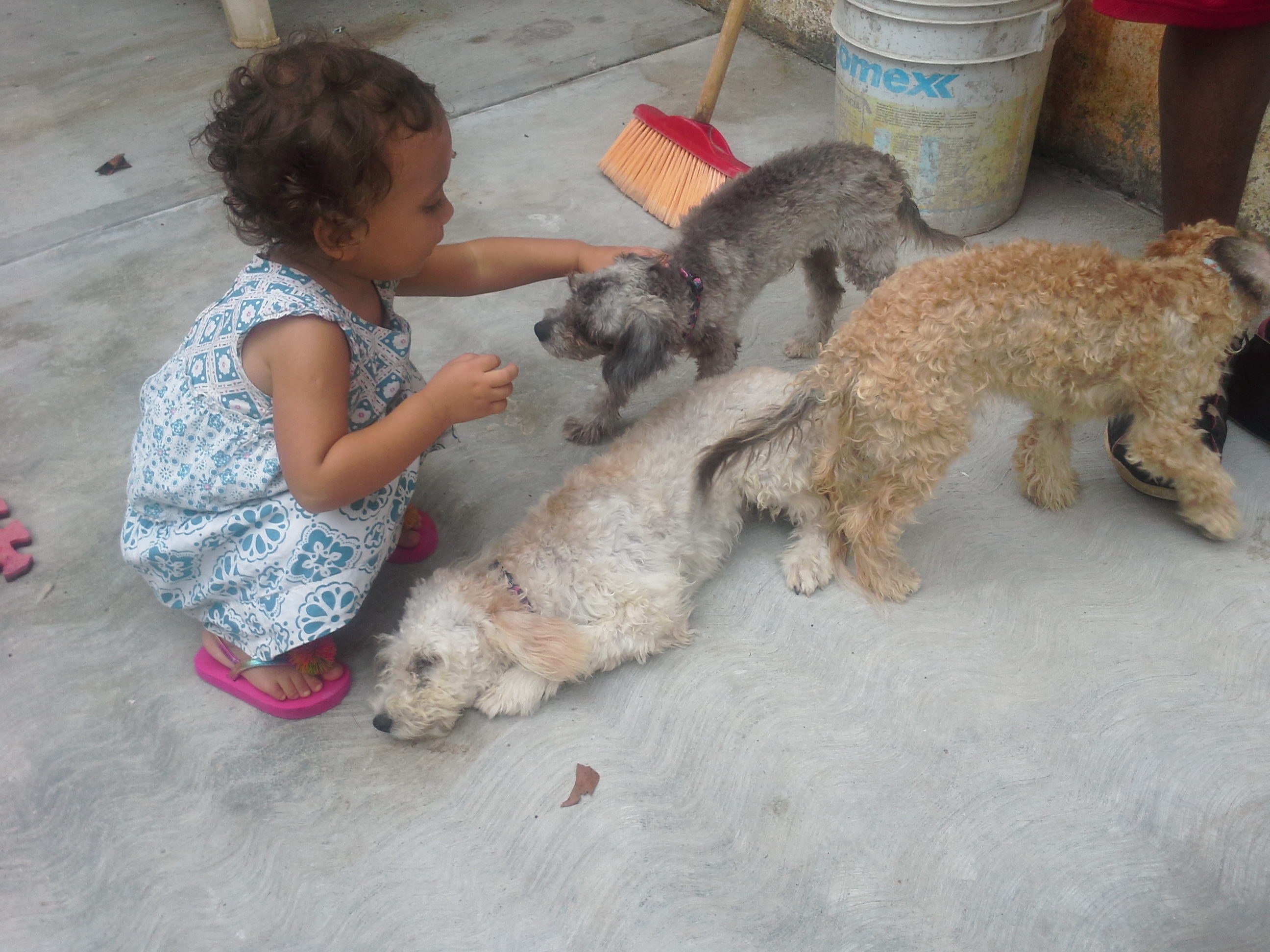
Lucia playing with Nery's puppies, who are far from mistreated

Lucia playing with Nery’s puppies, who are far from mistreated (by Nery at least. by excited children, maybe)


As much as I hate the idea of people mistreating their animals, I think I am more pissed off by this general culture of dogs as guard dogs, when half the time they are not even fenced in with what they’re guarding. Sometimes I’m walking down the street and there’s a dog presumably protecting its territory, but there’s no dividing line between the dog’s territory and the public domain. And you don’t even know if the dog you’re about to approach is a furious guard dog or a lazy bum who won’t even glance as you pass. Meanwhile, Conan has taught me that often being more dominant than the creature will make it back off. So you pick up or rock and get ready to throw it, or at least yell at the dog and swat your hand. It’s not a 100% guarantee, but it has worked for me some in this crazy jungle of dogs in my neighborhood. Mostly I felt okay to walk around wherever in the daytime, although less so at night when mean dogs have even more free reign.


Until a couple months ago. I was buying tortillas from this woman a few blocks away. She has two or three dogs who seem nice enough, probably neither mistreated nor spoiled, like a lot of dogs around. There was a super skinny-scrawny stray dog hanging around as well that day, but for the most part strays are not threatening. They are usually caught up in their own dog drama, quests for food and pleasant naps, so while I don’t rush up to make friends, I don’t fear them, either. I got my tortillas and strutted right past this one, but when I went to throw my leg over my bike I felt a sudden sting in my leg.


It took me a second to realize the dog had bit me, I was so surprised. I put the bike between us and it started to go around the bike. “Me mordió!” It bit me, I think I said, aghast, and the lady who makes the tortillas started yelling at a little girl, who was also buying tortillas, to get her dog. “Go take your dog home!” She scolded the girl. “It’s not my dog, ok,” she assured me, in case the dog put me off from buying tortillas there. The little girl was holding onto the muzzle of the dog I was sure had been a stray. I just nodded, got on my bike and rode back home.


Once I was at home and completely free from danger I discovered I felt a little shaky from the surprise of being bit when I was so utterly not expecting it. I inspected my leg and discovered it was a very small spot where it had broken the skin. I cleaned it with peroxide. I sat down and told myself it was no big deal. When I was four, I’d gotten a dog bite on my face that needed 20 stitches (from the beloved pet of a dear family friend), so certainly this was nothing in comparison. I started to calm down. But then, like any good hypochondriac, I started to think about diseases. I was up on my tetanus shots, so that pretty much only left rabies as a possible danger.


‘Rabies, once symptoms are present, is incurable and almost always fatal’ I read on the blessed information superhighway.  I checked to see what “almost always” really meant- only a handful of cases of survival, mostly of people who had previously had a rabies vaccine after a bite. I read about the agony people suffer while dying from rabies- including being terrified of water, unable to swallow, with excessive saliva running down your chin. “Death usually occurs within days of the onset of these symptoms,” the Centers for Disease Control and Prevention site reassured me- although can you imagine passing whole days like that?! Not sounding good for the home team.


I sat at the internet cafe and read about the rabies vaccine and the timeframe for effective prevention. I started to panic that I had cleaned my tiny wound with peroxide instead of the copious amounts of soap and water recommended by the internet. Hours had passed, so it was probably already too late for soap and water to wash out the dog’s saliva. It was probably already traveling through my bloodstream, while I was there wasting time reading about it.


Although it was not on my agenda for the day, I decided to pursue a rabies vaccine. But where to go for such a thing? Who to even ask? You don’t just google things around here and get answers. So I went to one of those pharmacy doctors, where you can get a free or cheap consultation, usually with no waiting.


I explained what had happened and the doctor examined my wound while- I’m pretty sure- trying not to laugh in my face. I tried to explain that I just thought it was better to be safe than sorry; that no, I didn’t know if the dog had rabies or not but that not knowing was exactly why I’d prefer to go ahead and get the vaccine. He said the hospital probably didn’t have it, and even if they did they probably wouldn’t give it to me because it’s a very expensive and hard-to-get vaccine. I tried to pressure him for any other possibilities on where to get the vaccine, and he assured me that my chances (both of getting rabies and of getting the vaccine) were low. Then we had a nice statistical chat about the risk of getting rabies when you’re bit by a dog versus being bitten by, say, a raccoon. And he threw in that really if you’re in the kind of place where you get bit by those kind of wild animals then you probably deserve it (okay maybe those weren’t his exact words, but close enough.). I was not impressed by the statistics because I could be in that small percentage and then there will be 100% of me dying a horrendous death in the very near future. I did not feel like he really appreciated my angst and anxiety about this rabies thing, to say the least.


Meanwhile I had called Conan to come get me, so after the unhelpful doctor I went and found him. “I just need to freak out for a minute,” I warned him, and proceeded to cry like a baby. “I know it’s super unlikely that I have rabies,” I choked out between sobs, “but I might! And it’ll be too late!” I continued.


“Okay. We’ll go find the vaccine.” Conan tried to reason and assure me.


“I don’t want the stupid vaccine. I don’t think I’ll get rabies….but I might!” And then he tried to tell me again to at least go find out if they’d give me the vaccine, at least make an effort if I was going to be all weirded out and worried about it. But still I refused. And still I continued to be upset, to lay out all the facts I had learned, to throw out some statistics, to reason about my odds. Unfortunately, it started to make Conan upset, too. We went to a friend’s house close by so I could (rather belatedly) wash my leg correctly with copious amounts of soap and water. Then I called my mom, the expert at letting me freak out and talk through everything without getting upset herself (or at least not showing it…must be all that psychology training I used to bitch about).


Talking through it helped, and I didn’t further pursue the rabies vaccine. And here I am writing this, not frothing at the mouth, a couple months after the fact. But now I am more cautious than I’d like to be. I don’t like to walk and bike around in fight-or-flight mode every time I see a dog, because I see dogs like every 10-60 seconds. And I’m not even particularly worried about being bit in and of itself; I’m not scared of the pain of it. I feel like I just need to be prepared for it. Well, and I might still be scared of rabies.


I’ve tried to figure out why this rabies thing was so panic-inducing for me. I mean, sure, mortality is always a little scary, but I do things that are much more likely to cause death than passing by dogs on a regular basis, and it doesn’t phase me. A traffic accident is much more likely to kill me than maybe getting rabies from maybe being bit by a dog, yet I don’t get scared crossing the street or riding in vehicles. I don’t flinch when there’s turbulence on the airplane. I smoked cigarettes for years, with only a nod at the very likely possibility of that killing me, even after watching my paternal grandmother die from it. And I certainly enjoy other little risks, like roller coasters. In general, I know it’s senseless to walk around calculating and worrying about everything because of course I could die at any moment from just about anything, just like everybody else.


Maybe it’s the idea of days of frothing at the mouth, hallucinating, afraid to even calm my thirst. Or maybe it’s the fact that there is this life-saving vaccine that I may or may not have access to. Or the most likely possibility, knowing myself, is how much I know I would beat myself up for not spending the time and energy to get a vaccine if I actually did get rabies, however unlikely. It’s imagining that regret would eat me alive before the rabies, spending whatever hours or days there were, between realizing I had rabies and losing my mind, repeating all the what-ifs that would make it un-happen, being mad at myself for not seeing it coming and doing something to change the fates. Absurd, right?


I guess it’s not so much about rabies, but about getting comfortable with things that make me uncomfortable, for better and for worse. I don’t want to get comfortable, for example, with people’s poverty and misery. Or at least I don’t want to be complacent about it. But I also realize that I can’t go around, say, handing out nutritious meals the way Karen can hand out dog food. Nor does it help anybody for me to be in a constant state of distress.


But I do want to get comfortable with the dog situation, with the complete unpredictability that is their animal nature. They’re not going away. Sure, I can keep being pissed off about the percentage of people here who train their dogs to “protect the house” aka be aggressive to people. I can be nervous every day, the multiple times a day I walk or bike down the street, but it’s not going to change anything.


I’d like to get to the point where I can be just slightly cautious, be aware of the dogs around me, without my heart racing in preparation every 30 seconds. I’d like to get to the point where I wouldn’t waste time blaming myself if something did happen, where I could put just a little more faith in the universe, where I could keep in mind a little better that what’s going to happen is bound to happen. So there’s my message to myself for the week: work on getting comfortable with the uncomfortable, rabid dogs and hypochondria and all. But I still expect somebody to put me out of my misery if I suddenly start to salivate.


*according to statistics from the House of Representatives (la Cámara de Diputados), from this report:

http://www.cronica.com.mx/notas/2013/721525.html

**Almost 20% of the population in the state of Oaxaca suffer from malnutrition, according to a report published by Mexican governmental agencies, and that’s a bit lower than some statistics from other sources- link

http://www.ciedd.oaxaca.gob.mx/info/pdf/16oct_dia_mundial_alimentacion.pdf

More than half the population under age 15 (in the state of Oaxaca) is living in “multidimensional poverty,” defined as a situation in which a person is not guaranteed at least one of his/her basic rights and the household income is insufficient to acquire needed services and goods. (loosely translated from this report (which is a really eye-opening read if you can read Spanish):

http://www.inegi.org.mx/inegi/contenidos/espanol/prensa/Contenidos/estadisticas/2013/niño20.pdf


Let the Rains Begin! (And Wash Away this Perfectionist Streak)

1 Jun

As the wind picked up and lightning flashed across the sky, Conan tried to convince me to wait with him and get a ride with a friend. “You can leave your bike here at Nery’s.” he suggested. “Or do you just like to suffer?” he pouted, the same way I do when I think he’s being foolish and stubborn.

Admittedly, I was feeling stubborn, and absolutely thrilled at the prospect of rain. There’s something about going six months out of the year without a drop of rain that makes even the promise of rain feel beautiful and magical again. In Juquila, I had dreaded the start of rainy season, since it meant the promise of six months of dreariness. In Juquila during rainy season it rains every single day, often for the whole afternoon and most of the night, occasionally for days on end. In Juquila, it meant feeling even more trapped inside the house. It meant wasting all the nice morning’s dry hours rushing to do chores and errands before the rain (since washing dishes was an outside chore, and you had to try to hang your clothes out in the sun for a couple hours so maybe they’d dry in less than three days, for example.). In Juquila rainy season is six months of misery only to be followed by wind storm season and then very cold season. But here in Puerto, where it doesn’t rain every day, and it mostly rains at night, and where the rain cools things down but doesn’t make it cold, I was feeling positive and excited about the seasonal change.

I was determined to ride home, too, because we’d just bought the bike that afternoon before I went to work. My old bike, that we’d bought used, had started breaking down every couple of days- one thing after another- and it was getting ridiculous to keep putting money into it. Having a bike is really important to me, because it’s one of my favorite forms of exercise, and just about everywhere here is biking distance. Plus it usually ends up being faster than public transport, and it’s free! So the need for the bike was strong. Normally, I wouldn’t rush into a big purchase like a brand new not used bike on the spur of the moment, but the transportation strike that afternoon pushed me into a quick decision.

Conan and Lucia and I had walked to the spot where colectivos (collective taxis) pass by, only to be told by a man that there were no colectivos coming. I thought he meant they were all on their lunch hour, which does happen and means a long wait time sometimes. “We’ll go walk out to where the buses pass, then, so at least we have more options,” I told him. “No, there are no buses, either. No taxis, either. There’s a paro (strike/protest),” he informed us.

We found out later that all the transportation folks (taxis, colectivos and buses) had banned together to prevent a new taxi company from doing business. Apparently it was some group who had money and thus good connections and was already getting their paperwork. So all the drivers who have worked for 15, 20 years and had to work hard to get their papers were furious.* At least this is my limited understanding of the situation.

Whatever the case, all of us without cars or functioning bicycles were walking. When we got to the main road, on the outskirts of our neighborhood, we could see that the whole road was blocked off by a bunch of buses and taxis and colectivos. I was pleased it was farther down the road than our house, away from town. We ended up able to get a ride with one of Conan’s cousins and thus avoided walking another 40 minutes or so to the market. We rushed and bought the second-cheapest bike that was small enough for me, a fancy clean white mountain bike that I’m still anxious to decorate (Send me some cool bumper stickers, please!).

After buying the bike, I’d gone directly to teach an English class just a measly 3 blocks ride away, so I was looking forward to using it to ride home. And the darkening sky was like a childhood friend double-dog-daring me to go. “I’ll get home before the rain. And before you get home, too!” I told Conan smugly. “I’m going right now before the rain gets here! You take my bag, just in case.” I kissed him and Lucia and took off. It got darker and even windier as I got closer to home. The lightning alternated between long rays touching down somewhere over yonder in the mountains and those gorgeous yellow, orange and pink giant horizontal flashes that seem to light up the whole sky. I pedaled faster, even while going downhill. Since I’ve only lived here for dry season so far, I’d never been in the rain here in Puerto, and had no idea what to expect from this kind of storm. It also reminded me of my days working at Lynn’s Paradise Cafe, my great friend Meg and I riding our bikes home together. Many times we chanced it with impending storms, racing home as fast as our legs would carry us, glancing at the sky, the adrenaline surging through us. I wished she were on this ride with me.

When I got to the entrance to my neighborhood, I thought, “Now I’ve almost made it.” Plus I knew that if the rain got crazy in the next couple minutes, there were two different places where I could stop and wait. But home would be better, so I kept up the pace, zooming past another guy on a bike. Unfortunately, it was dark and I’d forgotten about the speed bumps. I cursed in English going over the first one. The guy on the bike caught up to me just in time to hear my curse in Spanish flying/bumping over the second speed bump. I imagined, briefly, what it would be like riding my bike in the puddles of mud that my street would turn into once it started to rain.
But by the time I got to where the pavement ends I was more sure than ever that I would beat the rain. I flew over the big dirt speed bump that the arrogant neighborhood delegate had made in front of his house, cursing myself for not remembering. Almost there!

I almost slid in the sand that’s just around the curve going to my street, but righted myself in time. I saw my clothes hanging from the line and congratulated myself on getting home in time to keep my clothes dry, too, even though I’d forgotten about them. All labored breathing and sweat and electrifying heartbeats of adrenaline and triumph, I guzzled two cups of water. I sat down to slow myself down, to watch the storm roll in from the cozy nest that is my home, and to wait for Conan and Lucia to arrive.

Our friend brought Conan and Lucia, and the gorgeous displays of lightning kept up, with thunder sounding closer, but still the rain didn’t come. Eventually I went to bed, reluctantly, like an excited kid on Christmas Eve, telling myself I’d wake up when the rain started. But the land stayed dry.

The next night I did wake up, briefly but joyfully, to the sound of pounding rain. I reveled in the sound, in the smell, in the coolness, from the sweet shelter that is our bed in our lovely little house. A few evenings later, right at Lucia’s bedtime, we got to enjoy the rain together, our little family. We shined a flashlight outside so Lucia could see the drops come down. We stood in the doorway and let drops splash over us. I didn’t complain about delaying Lucia’s bedtime. I marveled at the cleansing sensation of moisture that’s not just humidity or my own sweat. We giggled in the novelty and freshness of it.

Image<Lucia with her Tia Artemia playing in her raincoat on a drizzly afternoon>


Like just about everything here, the rain didn’t happen when or how I expected it. Like so many things in Mexico, in life, I’d imagined and prepared for something, only to have bureaucrats or striking workers or inclement weather or other people’s whims or let’s call it destiny ruin my plans. I laughed at myself for having been so sure the rain was coming that night I raced on my bike. For buying a new bike in case the transportation strike kept up (it was over by the next day, although the bike is still important). For still fighting with myself all the time, my intense desire to plan for life and influence the outcomes butting up against my realistic if not heartfelt knowledge that I am not in charge. I am still daily trying to come to terms with the fact that my universe does not exist in a vacuum, that I can plan and prepare and wish for something till the cows come home, and the likelihood of that affecting the result is still about 50/50, on a good day.

I remember trying to give people updates about the house, or about other things we were doing or hoping to do since we moved here, and feeling foolish when they just didn’t get why it was taking so long. Things just happen here differently, or rather things don’t just happen; simple, everyday things are often more of a struggle than they are in the U.S. It took us like 5 days to get an extra key made in Juquila, for example. Just to get a house key! Every time we’d go to get it made, the place would be closed, and the first time we went and they were open we’d forgotten the key.

Or when we wanted to buy a bed for Lucia- for a reasonably priced bed, we had to get to Oaxaca City, 5 hours away, and figure out who could transport it back to Juquila for us. Not at all like driving down the road to Wal-Mart. Or you think you’re going to the grocery store one day but nope, you get there and it’s blocked by striking teachers again. Or just the other day, Conan was trying to deal with some tax situation for his grandmother who passed away over ten years ago. So he goes to the office, explains the situation. They say they can’t help him without an appointment. He asks if he can make an appointment. “No,” they say, “you have to make it online or over the phone at this 800 number.” He says he’s been trying to do it online and can’t get through. “Oh, yes,” they tell him casually, not an ounce of shame, “there’s a problem with the system, it’s over saturated and thus not working properly.” “Sooooo,” he says, and they’re like, “Just try in the early morning hours or late at night” which is especially tricky since we don’t have internet in our house, like most people around here. “Welcome to Oaxaca,” my mom would say (she’s got a really funny blog post if you want the back story on this inside joke: http://faustastories.net/2012/08/13/welcome-to-oaxaca/ ).

Here, much more so than in the U.S., you have to plan for things to not go as planned. “Julia, I think you’re gonna have to relax and go with the flow a little more if you’re going to live here,” my mom tried to caution me politely a week after we’d moved down. Ha! Let me tell you, I want to be a go-with-the-flow kind of person, I really do. Nobody wants to be that guy who’s devastated and grumpy all day just because their perfect biscuit recipe didn’t work because there’s no temperature control on the stupid oven here. And no, of course it’s not really about the biscuits or the temperature control, but the feeling that you lack any and all control over your life. (This may or may not be an accurate description of me in August 2012, 8 weeks into motherhood, one week into our Mexican exile- er, um, move.) No, no, let’s not be like that; let’s roll with the punches, guys! Listen to Bob Marley. Do some yoga.

So far yoga has not defeated my Type A personality. Bob has failed to convince me not to cry. Since I was itty bitty I have been a perfectionist, anxiously revising my Plans A, B, and C before being able to sleep at night. I was that kid who told her Mommy in preschool that she’d never get in trouble and have to go to time out, and then never did. I was that kid who wanted to do fire drills in her own home after learning about them at school. I was that teenager who was reckless and rebellious, but only because I carefully calculated what things I wanted to rebel against, when and how I would be “reckless”. I was and am a damn good spur-of-the-moment traveller, going where the wind blows me, appreciating all the moments for what they are- but only because my very intentional plan is to not have a plan in those moments.

Slowly but surely, I am recovering from this perfectionism, from this desire to believe I have control over my life. This wondrous job of motherhood has helped a lot; for example, for a while I was too exhausted to even get through Plan A in my head before falling asleep at night. Almost two years into this mothering adventure now, my child has taught me that I can expect any rigid expectations to be peed or pooped on, spat up, and/or vomited on regularly, just to keep me in check. And the lovely state of Oaxaca is doing its part, too. Oaxaca’s lessons for me, much like Lucia’s lessons for me, are not always pleasant, but I think they’ve been good for me, and I’ve grown fond of Oaxaca all the same. I am often forced to blow off my own plans, to make to-do lists in pencil and not pen, to laugh wildly at my expectations of ten minutes ago, to rethink what I thought I knew, even about the rain. Sometimes all this just makes me angry and crazy and frustrated and helpless-feeling. But more and more, I really can relax and laugh it off, change my plans and beloved ideas at the drop of a hat and call it destiny. I can feel not-miserable when the rain doesn’t come when I think it has to, and not be shocked when it appears out of the blue. So let this year’s rains keep coming, and wash away a little more of this perfectionist thing that’s been weighing me down. Please and thank you. 

*Their protest was effective, by the way; the new group did not start driving taxis, at least not yet.

Mama’s Revenge

19 May

“If you ever bring home an iron and have the audacity to call it a present, it’s grounds for instant divorce,” I’ve warned Conan since before we were married. Not that he’s the type for that, but just in case anyone around here were to put crazy ideas in his head. Because the most typical presents for moms around here are pots and pans and tupperware and a million other items with which to do chores. Stop the excitement; it’s just too much for me.

As if this suggestion that Mama’s only interest is her household duties were not bad enough, here in my very own beloved neighborhood in Puerto they took the cake this Mother’s Day. It’s always celebrated in Mexico on May 10, and this year it was a Saturday. At least all the moms didn’t have to get the kids ready for school. Maybe Mama could sleep in a little bit (unless she has a 2 year old like mine that has a 7 AM internal alarm).

I had to work early-ish anyway, so it wasn’t like I was planning on sleeping till noon. I was not planning on the fireworks starting at FIVE O’CLOCK IN THE MORNING, either. That’s right; two hours before I needed to get up, that jerk-off, arrogant neighborhood delegate down the street decided to “celebrate” and “congratulate” all us excited Mamas in the neighborhood. He set off a bunch of fireworks, first, and then put Las Mañanitas (a sort-of Happy Birthday song in Mexico, much longer than the “happy birthday to you” business) on his loudspeaker.
It sounds something like this:

Now every neighborhood has their own loudspeaker, their own announcer. You need this to make important announcements. Like the other day, they got all the men together to clean up the creek bed down the road. Or they announced info about Kids’ Day events recently. Or they might announce that there’s a vaccination campaign at the health center. Or they announce that there are tacos being sold at so-and-so’s house, or discounts at the pharmacy today. And yes, of course they use the announcer to congratulate and celebrate people on their birthdays or for other special moments. This is reasonable.

Waking up all the tired mamas, all their cranky babies, all their excitable kids, and everyone else in the neighborhood in the darkness of the five o’clock hour, however, is totally, completely outrageous. And rude and presumptuous. How dare they set off fireworks in our honor at such an ugly hour! Who’s gonna see those fireworks at that hour? “Doesn’t he have a wife, this stupid announcer of ours? Isn’t she a mother?” I asked Conan, who was pretending to sleep, in vain. “Doesn’t his wife have any sense or decency, even if he doesn’t? Does he think moms around here need to wake up any earlier, what with all the cooking and cleaning and washing they already do for umpteen hours a day? Does he think moms haven’t lost enough sleep thanks to the wonders and magic of motherhood already?! Does he think anyone cares about his stupid fireworks!?” I was becoming hysterical, using up excessive amounts of pre-coffee energy on my ire.

“Try to go back to sleep,” Conan advised me. I almost bit his head off, too, until I remembered that he was on my side, and that trying to go back to sleep was probably the only reasonable thing to do. Tragically, though, I’m not always a reasonable person, especially early in the morning before caffeine. So instead I lay there stewing, listening to repetitions of Las Mañanitas, listening to the other “celebratory” songs he alternated with. I wanted to throw things when he again muttered his confident and totally ironic congratulations to all us proud and ecstatic moms out there. (And I say he muttered because nothing on these loudspeakers ever comes out really clearly; it all sounds like muttering to me.)

So there I lay, plotting my revenge. Planning the organizing for my protest. Mulling over the pros and cons of going directly to his house, by myself, immediately (cons: still dark out, possibility of biting dogs loose at this hour, have to get dressed, doesn’t exact revenge) or waiting and organizing among the other (surely as rabid as I) moms in the neighborhood (cons: requires patience, probably still won’t involve me making a giant scandal outside his house at 3AM when he least expects it, won’t give me back these 2 lost hours of sleep).

In the end, the darkness of my house, the comfort of our family bed, and the hope of future revenge convinced me to stay home. By six all had quieted down outside, though not in my dark and bitter heart. Since then, Conan investigated some for me and found out that another guy in the neighborhood who got out of control with his announcing duties had a vigilante neighborhood group come together and take away his loudspeaker. So something, certainly, can be done. Some collective mom action can and will be done, if I have anything to say about it. Whether it will be sufficiently just revenge or not is for the future to tell. I’ll let you know, and I promise I won’t set off fireworks in front of your house when I do.